
Kaolinite-Based Hybrid Photocatalysts: TiO2/Reduced Graphene Oxide System for Degradation of Dyes and Pharmaceuticals
-
Nahida Nargis
Department of Environmental Science and Engineering, Chang'an University, China
Prabal Barua

Department of Environmental Sciences, Jahangirnagar University, Dhaka, Bangladesh
Noor MohammadOrganizational Operation and Human Resources Management, Chang'an University, China
| Received 06 Aug, 2025 |
Accepted 10 Oct, 2025 |
Published 31 Dec, 2025 |
The persistent presence of dyes and pharmaceuticals in water presents significant environmental and health risks, as these pollutants are often resistant to conventional treatment methods. Photocatalysis with Titanium Dioxide (TiO2) has been extensively used for the degradation of these pollutants; however, its narrow band gap and fast charge recombination limit its practical use. In recent years, several studies have focused on the use of kaolinite, a low-cost and abundant type of clay, for synthesising composite photocatalysts to enhance their performance. This paper highlights the recent development of kaolinite-based photocatalytic materials in terms of structure, preparation, and working principles. Kaolinite’s layered structure, abundant hydroxyl groups, and surface charge facilitate efficient charge transfer and adsorption of pollutants. The review also highlights how kaolinite composites can be modified to improve their responsiveness to visible light. Hybrid materials have demonstrated increased effectiveness in pollutant degradation, hydrogen production, and bacterial disinfection, outperforming single-component semiconductors. While laboratory studies show promising results, challenges remain in scaling up production, understanding charge transfer at interfaces, and developing more environmentally friendly methods. The review suggests that further research is needed to optimise the development of cost-effective, durable kaolinite-based photocatalysts for large-scale contamination remediation. Hybrid photocatalysts composed of kaolinite, particularly those incorporating TiO2 and Reduced Graphene Oxide (rGO), have shown great promise in degrading dyes, pharmaceuticals, and other recalcitrant water pollutants. The unique layered structure and surface chemistry of kaolinite enable efficient pollutant adsorption and uniform dispersion of semiconductor nanoparticles, leading to enhanced charge separation and photocatalytic activity under visible light.
| Copyright © 2025 Nargis et al. This is an open-access article distributed under the Creative Commons Attribution License, which permits unrestricted use, distribution, and reproduction in any medium, provided the original work is properly cited. |
INTRODUCTION
Synthetic dyes and residues of pharmaceuticals are considered a source of constant environmental and human health problems because of the toxicity, recalcitrance, and immunity against natural treatment processes, including biological degradation and adsorption1,2. The possible use of Titanium Dioxide (TiO2) as a semiconductor photocatalyst has been extensively studied due to its sound chemical stability and non-toxicity, and its capability to generate strong oxidizing power3. This, however, is hampered by its intrinsic shortcomings, such as a wide bandgap (~3.2 eV) that confines activity to ultraviolet light and high recombination of photogenerated electron-hole pairs, and thus cannot be used under natural sunlight4.
In ensuring that such shortcomings are overcome, recent studies have been oriented toward the incorporation of TiO with natural clay minerals (Kaolinite), which consist of a stable 1:1 aluminosilicate structure, hydroxyl-rich and negatively charged surface5,6. This eases robust interfacial bonding enabled by TiO-O-Si and TiO-O-Al bonds to encourage an energetic charge separation and decrease recombination losses7,8. Highly positive surface chemistry of Kaolinite can also enhance the adsorption of pollutants, further enhancing photocatalytic capability.
These developments have gone into the ternary and quaternary composites that combine Kaolinite and TiO2 with other substances such as Reduced Graphene Oxide (rGO) and graphitic carbon nitride (g-C3N4) to synergistically increase the visible-light absorption potential, charge carrier mobility, and the reactive oxygen species production7,9,10. This kind of heterojunction allows the almost complete degradation of dyes and pharmaceutical pollutants in the presence of visible-light irradiation and shows substantial superiority compared to more basic systems.
Sol-gel, hydrothermal, co-precipitation, and mechanochemical approaches are variously used to attain homogeneous dispersion of semiconductor, optimal particle sizes, and enhanced surface properties on Kaolinite11,12. The synthesis parameters have direct effects on the crystallinity, porosity, and also the photocatalytic activity.
Although work in the laboratory shows progress, real-life applications are adversely affected by issues such as the mixed nature of wastewater, leaching of nanoparticles, stability of catalysts, and the problem of reusability. These points are essential for the actual application of Kaolinite as a photocatalyst in the environment12,13.
A specific knowledge of the charge transfer dynamics in kaolinite heterojunction is lacking. It is important to understand and aid in the design of highly efficient photocatalysts by characterizing the processes and utilizing computer codes to model them at scale so that large-scale water treatment can be implemented13,14. Within the framework of sustainable water management, this research is based on the findings of some pivotal studies on water reuse and biofiltration in Bangladesh aquaculture systems, thus displaying environmental and practical significance14,15.
This survey summarizes the recent advances, outlines existing problems, and reveals new opportunities to develop efficient, up-scalable, and environmentally benign kaolinite-based photocatalysts to address the global water pollution issue.
FUNDAMENTALS OF KAOLINITE AND PHOTOCATALYSIS
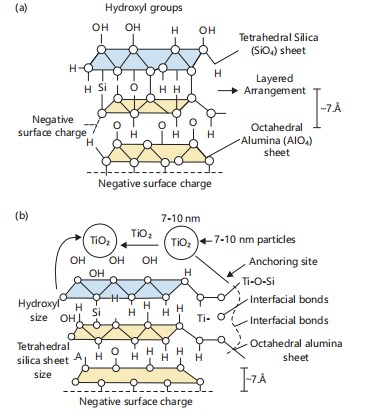
Kaolinite is the 1:1 Aluminosilicate clay mineral, which is usually found in abundance, especially in nature, in the form of a clay mineral commonly known as Kaolinite and whose chemical formula is Al2Si2O5(OH)4. The crystal structure is in the form of alternate octahedral alumina sheets and tetrahedral silica sheets connected by common oxygens in a non-expanding stable lattice (Fig. 1a)2,14. Kaolinite has large amounts of hydroxyl (-OH) groups on its surface, which is of paramount importance in the adsorption of the pollutants via electrostatic interactions and strong chemical bonds formed between the kaolinite surface and the semiconductor nanoparticles, including TiO25,16. These surface oxyhydroxyls are also electron traps, which inhibit charge recombination, leading to better photocatalytic activity. The interface between
|
Kaolinite and TiO2 is formed by a Ti-O-Si and Ti-O-Al interface, which makes the heterojunction interface stable, which is crucial to efficient charge separation (Fig. 1b)4,17. This well-established interface increases electron transfer between TiO2 and Kaolinite and consequently minimizes the recombination of the photogenerated electron-hole pairs and prolongs the lifetime of the charge carrier under illumination4. Such dynamical interactions mediate the production of Reactive Oxygen Species (ROS) that mineralise organic pollutants in the process of photocatalysis. TiO2 is one of the most popular photocatalysts since it is chemically stable, non-toxic, and has high oxidative capacity3. However, its broad bandgap (~3.2 eV in anatase) limits absorption to the ultraviolet portion of the color spectrum-a minuscule portion of the solar spectrum3,11. In addition, TiO2 has a short lifetime electron hole, which lowers the power of photocatalysis3,18.
The TiO2/Kaolinite combination helps to resolve these limitations and improve light collection, improve the adsorption of pollutants, and adsorb charge separation2,9,19. Additional synergetic improvements are accomplished by materials with conductivity, such as Reduced Graphene Oxide (rGO) or graphitic carbon nitride (g-C3N4), that enhance electron transfer and visible-spectrum absorption (Fig. 1c-d)6,7,20. Best photocatalytic degradation efficiencies in ternary and quaternary heterojunction systems under visible light were found to be higher than those of binary composites.
Most of the current studies are focusing on the need for uniform dispersion and high interfacial bonding of semiconductor particles to maximize the surface area and active sites on the kaolinite surface2,9,21. The layered structure of Kaolinite offers a superb scaffold, in which aggregation of nanoparticles is reduced and photocatalytic activity is obtained14. There is still a limited understanding of the mechanical processes involved in charge transfer through the states within kaolinite-based heterojunctions. Further spectroscopic and computational studies are essential to help illuminate those processes and inform the development of effective photocatalysts to be used in environmental remediation14,22.
SYNTHESIS AND MODIFICATION STRATEGIES
Kaolinite-based photocatalysts presented in this study can be synthesized and optimized in terms of their surface and structural properties to optimize their performance in environmental cleaning. The anchoring of semiconductor nanoparticles like pristine TiO2 on kaolinite is carried out by different physical, chemical, and hybrid techniques to optimize interfacial contact formation, particle dispersion, and the properties of the substance to suit the required application7,8,15 .
Sol-Gel method: Synthesis of kaolinite/TiO2 composites by the sol-gel approach is standard. During this process, titanium precursors (e.g., titanium isopropoxide) are subjected to a controlled hydrolysis and condensation process in the presence of kaolinite, and the kaolinite surface becomes coated by uniform TiO2 layers8. The following drying and calcination can make the anatase TiO2 nanoparticles crystalline, retaining the kaolinite layered structure. The sol-gel technique has the advantage of excellent control over particle size and composition, as well as homogeneity that directly determines the photocatalytic activity.
Hydrothermal and solvothermal: Such processes are based on the treatment of the precursor mixtures at high pressure and moderate-high temperature within the sealed autoclaves. The hydrothermal synthesis enhances the crystallinity and the uniformity of particle distribution of TiO2 on kaolinite15,23 . The variants of solvothermal incorporate organic solvents in order to tune reaction kinetics and particle shape. The techniques tend to give more porous and active surface sites in composites that lead to increased photocatalytic degradation rates15,24.
Mechanical and mechanochemical methods: Energetic ball milling or grinding with semiconductor precursor in synthesis is referred to as mechanochemical synthesis of kaolinite. This method enables close mixing, comminution of particles, and surface activation, and does not need solvents, as such, this is a green and scalable process8. Such mechanical techniques may create surface flaws and enhance interfacial bonds, and so lead to better transfer of charges in composites.
Activation and calcination: The crucial impacts of calcination temperature and duration on the phase composition, crystallinity, and surface chemistry of kaolinite/TiO2 composites are crucial. Optimized calcination will favor the greater formation of anatase phases, improve the dispersion of particles, and additionally eliminate residual organics, which altogether translate to enhanced photocatalytic activity8,15. It is possible to increase the surface hydroxyl groups and porosity through activation treatments of the kaolinite precursor, e.g., heat treatment (thermal activation) or acid/base16,25.
Activations (Acid and base): Acid treatment (e.g., HCl, H2SO4) or base (e.g., NaOH) treatment can alter the surface properties of kaolinite to raise surface area, create new active sites, and alter the properties of the surface charge profile25,26. The acid activation usually clears the impurities and increases pore volume. In contrast, the base activation can cause partial dissolution of the aluminosilicate structure or alteration of the structure, which influences the photocatalytic behavior26,27.
Doping and hybridisation: Addition of metal/non-metal dopants (Fe, Ce, N, S) to TiO2 or kaolinite causes alterations in bandgap energies which enhance visible-light absorption and charge carrier separation11,18,20. This is combined with hybridization with conductive materials such as the Reduced Graphene Oxide (rGO) or the graphitic carbon nitride (g-C3N4) to create heterojunctions that improve the delivery of electrons, avoiding recombination-based losses and leading to better performance in photocatalysis6,7,10,22.
Template methods and self-assembly: Self-assembly capitalizes on the fact that non-covalent interactions provide sufficient driving forces to assemble nanoparticles or nanosheets on the kaolinite surface to form patterned, morphology-controlled, and hierarchically porous materials that are advantageous in mass transport and the exposure of surfaces15,16. Template-directed syntheses employ kaolinite as a structural scaffold or a so-called sacrificial template to produce porous or hollow photocatalysts with a greater light-harvesting surface area (Fig. 2).

|
On the whole, such synthesis and modifying approaches present an opportunity to accurately design kaolinite/TiO2 photocatalysts with engineered structural, textural, and electronic features and apply these results in terms of effective degradation of refractory organic pollutants.
MECHANISTIC ROLE OF KAOLINITE IN PHOTOCATALYSIS
Kaolinite also plays an important mechanistic-based role in the enhancement of photocatalytic activity of composites, specifically when in combination with TiO2, and other forms of materials such as Reduced Graphene Oxide (rGO). The structural and surface properties of Kaolinite give rise to various synergistic benefits as summarized in Table 1, which overall enhance charge separation, light harvesting, and adsorption of pollutants, and enhance the overall photocatalytic effect.
Table 1 explains that Kaolinite has a 1:1 structure of aluminosilicate crystals layered and has a large quantity of surface hydroxy (-OH), making its surface negatively charged. The mechanism of high adsorption of cationic pollutants, including methylene blue and other dyes, onto titania due to this electrostatic property enhances the local concentration of the pollutants around active photocatalytic domains5,17,19. Furthermore, the presence of hydroxyl groups on Kaolinite provides anchoring sites where anchoring of TiO2 nanoparticles takes place, thus stabilizing them to avoid aggregation and enhancing even dispersion of TiO2 nanoparticles4,28. The stable Ti-O-Si and Ti-O-Al interfacial bonds formed on the interaction of Kaolinite and TiO2 also become a good heterojunction to activate photocatalytic reactions due to charge transfer and reduce electron-hole recombination4,21.
The key photocatalytic semiconductor is TiO2 nanoparticle in the anatase phase (usual size of 7-10 nm), which is used to absorb UV and visible light to produce photogenerated electron-hole pairs3. The holes are not transported away and are instead trapped by TiO2. The photogenerated holes stay on TiO2, whereas the electrons effectively move to the kaolinite surface, a process that minimizes recombination and allows the reactive oxygen species (ROS) to be produced to destroy the pollutants efficiently. The consequence is that the synergy of the two contributes a substantial enhancement of photocatalytic performance, as evidenced in performance tests11,21 of 2.5-fold higher than in the case of pure TiO2.
Also, in the composite formed with conductive materials like Reduced Graphene Oxide (rGO), the benefit is achieved with improved conduction of electrons and ease of charge carriers. The defect-riddled rGO sheets are small surface area electron acceptors and conductors, and, due to the high surface area, contribute to efficient charge separation7,22. The heterojunctions participating in the Z-scheme can minimize the recombination losses, which leads to higher stability of photocatalytic activity and degradation14.
Such multicomponent synergy is depicted schematically in Table 1, in which the contribution of each component in the form of contents and the structural role, the photocatalytic effect, the corresponding mechanism advantage, and the experimentally observed performance improvement are delineated. The synergistic effect in improving pollutant degradation of Kaolinite and its surface chemistry, as well as structural stability, TiO2, caused by light absorption and charge generation, and rGO conduction pathways, opens up the possibility of making more efficient and sustainable photocatalytic materials (Table 1-2).
PHOTOCATALYTIC APPLICATIONS OF KAOLINITE-BASED MATERIALS
The composites made of kaolinites have received a great deal of attention in connection with the environment-related uses as a result of the synergic interactions between the adsorption potential of the kaolinites and semiconductor photocatalytic performances. The set of materials is highly effective in eliminating a broad scope of organic pollutants, including synthetic dyes, pharmaceutical byproducts, and heavy metals, through a synergistic effect that integrates adsorption and photodegradation processes to improve upon the performance of existing technologies to clean up contaminated water18,19.
| Table 1: | Roles and contributions of components in kaolinite-based ternary photocatalytic composites, summarizing structures, mechanisms, and enhanced pollutant degradation | |||
| Component | Structural role | Photocatalytic function | Mechanistic advantage | Performance enhancement |
| Kaolinite | -1:1 layered aluminosilicate structure (Al2 Si2 O2(OH)4)- Surface hydroxyl groups (-OH) |
-Electrostatic adsorption of cationic pollutants- Stabilizes metal oxide nanoparticles |
-Forms Ti–O–Si and Ti-O-Al interfacial bonds with TiO2- Increases the surface area and adsorption sites |
-Up to 99% dye degradation efficiency - Enhanced light harvesting due to kaolinite’s surface properties |
| TiO2 | -Anatase phase nanoparticles (7-10 nm)- Uniform size distribution |
-Primary semiconductor photocatalyst-Absorbs UV/visible light |
-Photogenerated holes remain on TiO2- Electrons migrate to the kaolinite surface to prevent recombination |
-2.5×higher activity than pure TiO2- Enhanced photocatalytic performance due to kaolinite integration |
| Reduced Graphene Oxide (rGO) |
-2D graphene sheets with defect sites-High surface area and conductivity |
-Electron acceptor and conductor -Facilitates charge transfer in photocatalytic processes |
-Forms Z-scheme heterojunctions -Acts as an electron sink to reduce recombination |
-Reduces recombination losses by 80% -Improved stability and photocatalytic activity compared to pure TiO2 |
| Table 2: | Key research priorities and future opportunities for advancing kaolinite-based photocatalysts, highlighting the transition from laboratory innovation to scalable, sustainable, and multifunctional environmental remediation technologies | |||
| Research area | Current status/Limitation | Future opportunity/Priority | Expected impact |
| Scalable and green synthesis | Energy-intensive, multi-step lab methods; limited scalability |
Develop low-energy, green, and continuous-flow synthesis methods for large-scale production |
Cost reduction, industrial adoption |
| Visible-light utilization | Most composites remain UV-dependent, low solar efficiency |
Bandgap engineering via doping (Fe, Ce, N, S) and hybridization with narrow-bandgap semiconductors |
Enhanced solar-driven photocatalysis |
| Mechanistic understanding | Incomplete knowledge of charge transfer and interfacial electron dynamics in composites |
In-situ spectroscopy (TRPL, EPR), DFT modeling for better understanding of electron and hole behavior in composites |
Rational catalyst design, higher efficiency |
| Hybrid and multifunctional systems | Mostly binary/ternary composites, limited multifunctional systems for energy and pollutant removal |
Develop membranes, biohybrids, and energy storage systems integrated with photocatalysts |
Simultaneous pollutant removal and energy production |
| Real-world performance | Lab tests use model pollutants, real wastewater matrices affect performance due to complex composition and ions |
Test in real wastewater matrices; hierarchical pore structures for enhanced resilience and performance in practical settings |
Reliable operation in practical conditions |
|
Kaolinite has a layered organization with a lot of hydroxy groups that give high adsorption of cationic pollutants, gathering the contaminants close to photocatalytically active domains5,17. UV and visible light-activated absorption by TiO2 nanoparticles embedded on kaolinite surfaces produces Reactive Oxygen Species (ROS) to oxidize and mineralize organic pollutants without producing any secondary waste11,21. Addition of electroactive materials, e.g., Reduced Graphene Oxide (rGO), improves charge separation and transport of the electrons, enhancing degradation in visible light7,10.
These appear as photocatalytic capabilities that have been proven in various experiments. As an example, combustion of kaolinite/TiO2 composites has 99 percent efficiency to remove dyes like methylene blue and rhodamine B in cleanup experiments17,29. On the same note, ternary composites that include rGO have demonstrated less recombination losses and better degradation properties of pharmaceuticals22. These materials have good restoration and reuse properties, which promote their practicality, but long-term stability is a significant issue to consider when scaling operations23,24.
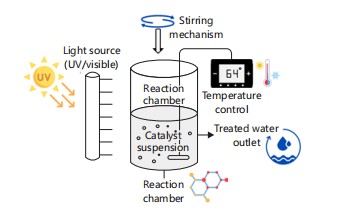
Photocatalytic reactors, Lab-scale reactor, Fig. 3, are typically implemented to test the efficiency of kaolinite-based composite. The standard features of this reactor system are UV/visible light sources, temperature controls, mechanical stirring as a means of providing homogeneity, and the provision of sampling ports to observe the degradation kinetics of pollutants. Increment in the efficiency of these parameters through optimization permits the arrangement of continuous studies towards augmenting catalytic capacity and discerning the effect of real wastewater matrices on photocatalytic behavior.
With the favorable laboratory performance, the implementation of these materials in a real wastewater treatment shows some difficulties since these industrial effluents may affect the photocatalytic activity by making the ions compete along with the natural organic matter and changing the pH27,28. Thus, future research will focus on conducting tests under realistic conditions and creating materials with multiple functions that allow performing both adsorption and photocatalysis in various environmental media.
To sum up, the use of the kaolinite-based photocatalysts demonstrates a highly adaptable and efficient method of cleaning up wastewater, which uses the properties of adsorption and photocatalytic-driven oxidation. Their scaleability, economical nature, and environmental friendliness make them an excellent prospect for future industrial water treatment technologies (Fig. 3).
CHALLENGES AND LIMITATIONS
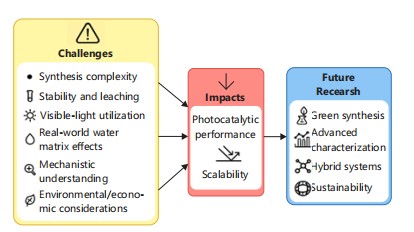
Although encouraging results have already been obtained, the application of synthesized kaolinite-based photocatalysts still has to deal with several critical challenges that are interrelated and affect the efficiency and scalability of the processes involving photocatalysis. According to Fig. 4, some problems are the complexity of the synthesis, the challenges of sustaining long-term stability, the regulation of leaching of the metals, inadequate application in visible wavelengths owing to the large bandgap in TiO2, and considerable fluctuations in applications in real water matrices29-31. Furthermore, the lack of mechanistic details of charge separation and transfer processes, as well as critical environmental and economic factors, hinders the widespread industrial application of such materials in industrial water treatment.
|
Such implications of challenges directly affect the key photocatalytic performance and the possibility of extensive implantation. As an example, complicated multistep syntheses can limit the scalability of production, and a lack of stability or solubility potential can be questioned by environmental standards and regulatory obstacles23,24. Inefficient visible-light response continues to hinder the application of solar energy, and random variation in real wastewater makeup can cause unexpected low degradation rates because of reactive oxygen species competition or inhibition25,26.
All these interconnections are summarized graphically in Fig. 4: issues deemed as major (yellow), their immediate consequences (red), and the research directions into the future that it is necessary to pursue to overcome these challenges (blue), including the introduction of green synthesis methods and usage of state-of-the-art characterization tools, development of hybrid and multifunctional structures, and sustainability assessment.
The systematic processes needed to overcome these challenges are catalyst design, mechanistic studies, real-matrix testing, and life-cycle assessment to achieve robust, environmentally safe, and cost-effective new materials to implement wide-scale environmental remediation. The strategic directions shown in Fig. 4 draw upon the guided pathways to help develop kaolinite-based photocatalysis into actionable and meaningful solutions.
FUTURE PERSPECTIVES
To enhance the development of kaolinite-based photocatalysts to the next level, i.e., the sustainable and practical environmental remediation, there is a need to research specific drawbacks and prospects of the field.
Green and scalable synthesis: Low-energy, environmentally benign synthesis methods need to be developed to facilitate the production of highly active kaolinite/TiO2 composites in large quantities. Continuous-fried sol-gel procedures, mechanochemical tactics, and bio-influenced molding can be used to lessen the energy use, eliminate the pernicious reagents, and enhance the constituent consistency27,28. As an important future objective, these environmentally friendly methods should be scaled up whilst not compromising performance on photocatalysts.
Bandgap engineering and visible light: It is important to extend the photocatalytic response into the visible region to utilize solar irradiation effectively. Doping of transition metals and non-metals within the so-called earth-abundant category and hybridization with narrow-band semiconductors (such as graphitic carbon nitride and conductive carbons [e.g., reduced graphene oxide] are also likely approaches11,18,20,22 . State-of-the-art computational design and in situ spectroscopic analysis will facilitate faster discovery of optimal types and concentrations of dopants to provide balanced charge separation and light harvesting.
Multifunctional hybrid systems: Adsorption and photocatalysis or adsorption and antimicrobial functionalities can be combined in one kaolinite-based composite to attack complex wastewater matrices. Specific surface chemistry and hierarchical porosity of ternary and quaternary heterojunction design will improve pollutant adsorption and degradation kinetics and recycling of the catalyst6,7,10. The multifunctional platforms using water treatment using photocatalysis combined with membrane technology or biohybrid materials also have bright future scopes.
Mechanistic insights and interface engineering: Improving the insights into charge transfer processes, the electronic structure of the interface, and the generation of reactive species within a realistic operating environment is crucial. The use of sophisticated methods of characterization, including time-resolved photoluminescence, electron paramagnetic resonance, and density functional theory modeling, will guide design principles to enhance active lifetimes and photostability12-14. High-efficiency photocatalysts can be industrialized more easily using precision control of interfacial bonding and surface defects.
Life cycle assessment and the real wastewater testing: The move to real wastewater matrices and the complex wastewaters where the activity of the catalyst is to be put to test is critical in justifying the performance of the catalyst and its functionality in practical situations. The protocols of a standardized testing process and the use of life cycle assessments will provide environmental health, economic sustainability, and circular economy compatibility when the technology is on a large scale29-31.
Integration of sustainability and circular economy: The next question to be answered by scientists of the future should be not only centered on performance, but also on resource use, recyclability, and end-of-life issues. To maximize the ecological and economic effects, the use of the kaolinite-based photocatalysts will be considered as a part of sustainable and closed water treatment processes where regeneration and re-usage of products are prioritized. The use of the natural abundance of kaolinite and cheap materials further facilitates sustainability adaptation31,32.
Overall, future investigations into the potential of kaolinite-based photocatalysts are to rely on green synthesis, material design at a higher level, allowing the use of solar energy across a broad spectrum, the hybridization of materials with multiple functions, detailed mechanistic understanding, and the assessment of material performance within realistic settings. Such initiatives altogether will spur the next decade of scalable, efficient, and environmentally friendly water treatment technologies utilizing photocatalytic technology (Table 2).
CONCLUSION
Kaolinite entailing hybrid photocatalysts, especially those combined with TiO2 and Reduced Graphene Oxide (rGO), have been proven most promising in the degradation of dyes and Pharmaceuticals among other classes of stubborn water pollutants. The layer and surface chemistry of kaolinite make it effective in adsorbing pollutants and dispersing nanoparticle semiconductors, having increased charge separation and photocatalytic activity even in visible light. Most recently, this functional performance of the said composites has been boosted further by a series of synthesis pathways, such as sol-gel, hydrothermal, and mechanochemical pathways, and applied in the elimination of impurities, hydrogen generation, as well as the decontamination of bacteria. However, several hurdles have to be overcome before these materials can be used in real-life situations en masse. Significant drawbacks are the difficulty, scalability, and reproducibility of synthesis processes, the stability and reusability of the materials in the long term, control of nanoparticle leaching, limited use of visible light, and the knowledge of charge transfer at interfaces. In addition, it needs to be tested under realistic water matrix conditions and a thorough environmental and economic analysis to authenticate the sustainability of these photocatalysts.
SIGNIFICANCE STATEMENT
This study discovered the potential of kaolinite-based hybrid photocatalysts, particularly those incorporating TiO2 and Reduced Graphene Oxide (rGO), that can be beneficial for the efficient degradation of dyes, pharmaceuticals, and other recalcitrant pollutants from contaminated water. The unique layered structure, surface hydroxyl groups, and charge characteristics of kaolinite enable enhanced adsorption of pollutants, improved charge separation, and extended photocatalytic activity under visible light. Moreover, recent synthesis strategies such as sol-gel, hydrothermal, and mechanochemical pathways have further improved the stability, efficiency, and multifunctionality of these materials. This study will help the researchers to uncover the critical areas of scalability, interfacial charge transfer, and environmental sustainability that many researchers were not able to explore. Thus a new theory on cost-effective large-scale photocatalytic remediation may be arrived at.
REFERENCES
- Chen, M.J., Y.R. Han, J.X. Hu, Y.J. Liu and B. Huang, 2023. Tolypocladium rhizomatum sp. nov.: An endophytic species isolated from the rhizome of Polygonatum cyrtonema. Phytotaxa, 606: 201-210.
- Liu, R., Y. Fan, R. Guo, X. Dong and X. Ma, 2024. Preparation of coal kaolinite composites and study of adsorption properties. Coal Sci. Technol., 52: 311-323.
- Maksudul Hasan, A.K.M., S.C. Dey, M. Mominur Rahman, A.M. Zakaria, M. Sarker, M. Ashaduzzaman and S.M. Shamsuddin 2020. A kaolinite/TiO2/ZnO-based novel ternary composite for photocatalytic degradation of anionic azo dyes. Bull. Mater. Sci., 43.
- Mustapha, S., J.O. Tijani, M.M. Ndamitso, A.S. Abdulkareem, D.T. Shuaib and A.K. Mohammed, 2021. Adsorptive removal of pollutants from industrial wastewater using mesoporous kaolin and kaolin/TiO2 nanoadsorbents. Environ. Nanotechnol. Monit. Manage., 15.
- Ayanda, O.S., K.O. Sodeinde, P.O. Okolo, A.A. Ajayi, S.M. Nelana and E.B. Naidoo, 2018. Adsorptive behavior of kaolin for amido black dye in aqueous solution. Orient. J. Chem., 34: 1233-1239.
- Septiansyah, S.I., I.H. Afandi and R.T. Dirtami, 2022. Activation of kaolin minerals from Ketapang Regency as Cu metal adsorbent material. EKSPLORIUM, 43: 103-110.
- Shaban, M., M.E.M. Hassouna, F.M. Nasief and M.R. AbuKhadra, 2017. Adsorption properties of kaolinite-based nanocomposites for Fe and Mn pollutants from aqueous solutions and raw ground water: Kinetics and equilibrium studies. Environ. Sci. Pollut. Res., 24: 22954-22966.
- Aloulou, H., W. Aloulou, J. Duplay, L. Baklouti, L. Dammak and Raja Ben Amar, 2022. Development of ultrafiltration kaolin membranes over sand and zeolite supports for the treatment of electroplating wastewater. Membranes, 12.
- Detellier, C., 2018. Functional kaolinite. Chem. Rec., 18: 868-877.
- Kong, E.D.H., J.H.F. Chau, C.W. Lai, C.S. Khe and G. Sharma et al., 2022. GO/TiO2-related nanocomposites as photocatalysts for pollutant removal in wastewater treatment. Nanomaterials, 12.
- Lata, N.P., M.S. Hussain, M. Abdulla-Al-Mamun, Taslim ur Rashid and S.M. Shamsuddin, 2024. Fabrication and synergistically enhanced photocatalytic activity of ternary kaolinite, TiO2, and Al2O3 (K65T30A5) nanocomposite for visible-light-induced degradation of methylene blue and remazol red dye. Heliyon, 10.
- Potbhare, A.K., S.K.T. Aziz, M.M. Ayyub, A. Kahate and R. Madankar et al., 2024. Bioinspired graphene-based metal oxide nanocomposites for photocatalytic and electrochemical performances: An updated review. Nanoscale Adv., 6: 2539-2568.
- Sagita, C.P., L. Nulandaya and Y.S. Kurniawan, 2021. Efficient and low-cost removal of methylene blue using activated natural kaolinite material. J. Multidiscip. Appl. Nat. Sci., 1: 69-77.
- Cheng, H., Y. Zhou and Q. Liu, 2019. Kaolinite Nanomaterials: Preparation, Properties and Functional Applications. In: Nanomaterials from Clay Minerals: A New Approach to Green Functional Materials Micro and Nano Technologies, Cheng, H., Y. Zhou and Q. Liu, Elsevier, Amsterdam, Netherlands, ISBN: 978-0-12-814533-3, pp: 285-334.
- Azeez, S.O., I.O. Saheed, F.A. Adekola and S.S. Salau, 2022. Preparation of TiO2-activated kaolinite composite for photocatalytic degradation of rhodamine B dye. Bull. Chem. Soc. Ethiop., 36: 13-24.
- Perez-Alvarez, J., D.A.S. Casados, S. Romero and L. Escobar-Alarcón, 2014. Photocatalytic degradation of malachite green dye and pharmaceuticals using Co:TiO2 thin films. Adv. Mater. Res., 976: 212-216.
- Ramesh, N., C.W. Lai, M. Rafie Bin Johan, S.M. Mousavi and I.A. Badruddin et al., 2024. Progress in photocatalytic degradation of industrial organic dye by utilising the silver doped titanium dioxide nanocomposite. Heliyon, 10.
- Sari, Y., P.L. Gareso and D. Tahir, 2024. Review: Influence of synthesis methods and performance of rare earth doped TiO2 photocatalysts in degrading dye effluents. Int. J. Environ. Sci. Technol., 22: 1975-1994.
- Sarma, G.K., S.S. Gupta and K.G. Bhattacharyya, 2019. Removal of hazardous basic dyes from aqueous solution by adsorption onto kaolinite and acid-treated kaolinite: Kinetics, isotherm and mechanistic study. SN Appl. Sci., 1.
- Sultana, M., A. Mondal, S. Islam, M.A. Khatun and M. Hafezur Rahaman et al., 2023. Strategic development of metal doped TiO2 photocatalysts for enhanced dye degradation activity under UV-Vis irradiation: A review. Curr. Res. Green Sustainable Chem., 7.
- Bai, C.H., S.L. Zheng, Z.M. Sun, S.M. Lei, J.Y. Gui, F.L. Lv and M. Wen, 2010. TiO2/kaolinite photocatalytic material of Fe3+ chemical doping and Fe2O3 heat-banding and its mechanism analysis. Adv. Mater. Res., 178: 324-329.
- Yu, L., W. Xu, H. Liu and Y. Bao, 2022. Titanium dioxide-reduced graphene oxide composites for photocatalytic degradation of dyes in water. Catalysts, 12.
- Reyes, C.A.R. and L.Y.V. Fiallo, 2011. Application of Illite- and Kaolinite-Rich Clays in the Synthesis of Zeolites for Wastewater Treatment. In: Earth and Environmental Sciences, Dar, I.A. and M.A. Dar (Eds.), IntechOpen, Rijeka, Croatia, ISBN: 978-953-51-4393-2, pp: 363-374.
- Ramísio, P.J., F. Bento, D. Geraldo, O. Andrade and A.P. Bettencourt, 2023. Evaluation of municipal waste compost in relation to the environmental retention of heavy metals. Sustainability, 15.
- Li, G., X. Liu, J. Zhang, J. Liu and Y. Yang, 2022. Investigation of the adsorption characteristics of Pb(II) onto natural kaolinite and bentonite clays. Desalin. Water Treat., 262: 121-136.
- Prasad, M.S., K.J. Reid and H.H. Murray, 1991. Kaolin: Processing, properties and applications. Appl. Clay Sci., 6: 87-119.
- Al-A'qarbeh, M.M., M.W. Shammout and A.M. Awwad, 2020. Nano platelets kaolinite for the adsorption of toxic metal ions in the environment. Chem. Int., 6: 49-55.
- Shaomin, L., G. Wenqi, B. Chunhua, Q. Yi, G. Yongqin, X. Bihua and W. Cheng, 2006. Preparation of TiO2/kaolinite nanocomposite and its photocatalytical activity. J. Wuhan Univ. Technol. Mater. Sci. Ed., 21: 12-15.
- Chowdhury, Z., S. Samrat and S. Barma, 2024. Synthesis, characterization and modification of cost-effective kaolin supported hydrothermally fabricated mesoporous silica membrane. J. Phys. Conf. Ser., 2818.
- Gupta, S.S. and K.G. Bhattacharyya, 2012. Using aqueous kaolinite suspension as a medium for removing phosphate from water. Adsorpt. Sci. Technol., 30: 533-547.
- Barua, P. and M. Barua, 2021. Applicability of water reuse for coastal shrimp ponds in Southern Bangladesh. Water Prod. J., 1: 25-42.
- Barua, P. and M. Islam, 2022. Applicability of water reuse through the treatment process of biofilter in freshwater prawn hatchery of Bangladesh. Int. J. Water Res., 4.
How to Cite this paper?
APA-7 Style
Nargis,
N., Barua,
P., Mohammad,
N. (2025). Kaolinite-Based Hybrid Photocatalysts: TiO2/Reduced Graphene Oxide System for Degradation of Dyes and Pharmaceuticals. Trends in Pharmacology and Toxicology, 1(2), 137-149. https://doi.org/10.21124/tpt.2025.137.149
ACS Style
Nargis,
N.; Barua,
P.; Mohammad,
N. Kaolinite-Based Hybrid Photocatalysts: TiO2/Reduced Graphene Oxide System for Degradation of Dyes and Pharmaceuticals. Trends Pharm. Toxicol. 2025, 1, 137-149. https://doi.org/10.21124/tpt.2025.137.149
AMA Style
Nargis
N, Barua
P, Mohammad
N. Kaolinite-Based Hybrid Photocatalysts: TiO2/Reduced Graphene Oxide System for Degradation of Dyes and Pharmaceuticals. Trends in Pharmacology and Toxicology. 2025; 1(2): 137-149. https://doi.org/10.21124/tpt.2025.137.149
Chicago/Turabian Style
Nargis, Nahida, Prabal Barua, and Noor Mohammad.
2025. "Kaolinite-Based Hybrid Photocatalysts: TiO2/Reduced Graphene Oxide System for Degradation of Dyes and Pharmaceuticals" Trends in Pharmacology and Toxicology 1, no. 2: 137-149. https://doi.org/10.21124/tpt.2025.137.149

This work is licensed under a Creative Commons Attribution 4.0 International License.