
Phytopharmacology and Therapeutic Applications of Some Commonly Used Gums, Resins and Oleo-Gum Resins in Unani System of Medicine
-
Mohd. Sayeed Akhtar


Depatment of Botany, Gandhi Faiz-e-Aam College, Shahjhanapur, Uttar Pradesh, India
Shaikh Ajij Ahmed MakbulDepatment of Ilmul Advia (Pharmacology), National Institute of Unani Medicine, Ghaziabad, Uttar Pradesh, India
Shamim Irshad AzmiDepatment of Ilmul Advia (Pharmacology), State Takmeel ut-Tib College and Hospital, Aurangabad Tiraha, Lucknow, Uttar Pradesh, India
| Received 03 Jan, 2026 |
Accepted 30 May, 2026 |
Published 30 Jun, 2026 |
Background and Objective: Plants that thrive in arid and dry areas are commonly used to produce oleo-gum resins, which contain traces of essential oils. Certain gums are the result of exudation, which mostly comes from a tree’s stem but can also occasionally come from its root. These natural chemicals play an important role in human health by preventing and treating inflammatory diseases. The aim of this article is to examine the literature on plant-based gums, resins, and oleo-gum resins used in the Unani system of medicine. In addition, their origins, identification, physicochemical properties, constituents, scientific investigations and pharmaceutical and food-related applications are also discussed. Materials and Methods: PubMed, Google Scholar, ScienceDirect, Web of Science, and Scopus were used as online databases to meet the review of literature. Arabic and Persian texts translated into Urdu by the Cental Council for Research in Unani Medicine were used as references for classic literature of Unani medicine. The terms included in the search included unorganised pharmaceuticals, plant exudates, resin, gum, oleo-gum resins, and pharmacological and scientific investigations on them. Results: Plant exudates like as gums, resins, and oleo-gum resins are frequently used as coating materials, adhesives, cosmetic preparations, fragrances in daily rituals, and therapies in both Unani and folk medicine. Their reduced side effects, low cost, non-toxic, stability, accessibility, eco-friendliness, and degradability properties have reignited the public’s interest. Conclusion: Gums, resins, and oleo-gum resins have been used by Hakims (Unani physicians) of the Unani School of medicine for the treatment of numerous human illnesses from ancient times, either as a single drug or in multiple dosage forms. It is used in the culinary, cosmetics, and pharmaceutical industries for a number of purposes.
| Copyright © 2026 Akhtar et al. This is an open-access article distributed under the Creative Commons Attribution License, which permits unrestricted use, distribution, and reproduction in any medium, provided the original work is properly cited. |
INTRODUCTION
Plant exudates are released by trees’ bark, branches, and fruit to protect them against microbial and mechanical harm1-5. Exudates are a class of naturally occurring bioactive compounds derived from plants that are commonly used for basic medical treatment in impoverished nations. Oleo-gum resins contain traces of essential oils and are frequently obtained from plants that grow in arid climates6. Exudation, which primarily originates from a tree’s stem but can sometimes originate from its root, produces some gums. Gum acquisition can also happen by tapping, either accidentally or due to insect borers. By preventing and treating inflammatory illnesses, these natural substances are essential to human health. Gum resins infused with essential oils are commonly used for incense and medicinal purposes7. During, the exudation pocess, the healthy plants produce the complex mixture of big and tiny molecules, as well as carbohydrates, proteins, amino acids, volatile compounds, and inorganic ions. Exudates have been utilized as emulsifiers, thickeners, binding agents, and coating agents in pharmaceuticals, food, fragrances, and cosmetics8.
Gums are aberrant products that develop as a result of pathological situations such as damage or unfavourable growth conditions, such as drought. They are usually formed by modifications to existing cell walls. As a result, they are aberrant plant metabolic products. Gums are transparent, amorphous solids that are either completely or partially water soluble. It is insoluble in alcohol and the majority of organic solvents. However, they can be dissolved in water to form viscous, sticky solutions or inflated into a jelly-like mass by water absorption9. While resins are combinations of essential oils, oxygenated terpene derivatives, and carboxylic acids found as exudations from the trunks of various trees and are generated in schizogenous or schizolysigenous ducts or cavities. These are substances that can be solid, semi-solid, or liquid characterized by their transparency or translucency and density greater than water10. They are insoluble in water, but are soluble in various organic solvents and oils10.
Plant exudates have been employed in Indian traditional medicine for thousands of years to treat asthma, joint ailments, eye diseases, ear, nose, and throat inflammations, neurological disorders, diseases of the paediatric and female reproductive systems, gastrointestinal problems, and as fumigation11 (Table 1). The collection of crude drugs is stated to be dependent on their natural habitat, geographical distribution, a specific period, and a specific season. A basic rule is that they should be gathered from a fully grown plant. When the active components are at their highest concentration, the drugs are collected. When gums have coagulated, they should be collected, but not so hard that they become frittered away12. Plant exudates have been shown to be used in traditional remedies according to ethnopharmacological investigations since ancient times, but very few scientific studies have been carried out on these products. Although scholarly papers highlight the therapeutic potential of exudates produced by plants, there is no comprehensive evaluation of plant exudates for medicinal purposes to date. Therefore, the aim of this article is to examine the literature on plant-based gums, resins, and oleo-gum resins used in the Unani system of medicine. In addition, their origins, identification, physicochemical properties, constituents, scientific investigations and pharmaceutical and food-related applications are also discussed.
MATERIALS AND METHODS
We surveyed and analysed pertinent books, articles, periodicals, and peer-reviewed indexed journals, and journals (from 2000 to 2025) that follow to COPE principles that are available on well-known online resources including PubMed, ScienceDirect, Web of Science, Google Scholar, and Scopus. Plant exudates, resin, gum and pharmacological studies on it were among the terms utilised for an online literature search. Inclusion standards are constrained to research regarding in-vitro or in-vivo pharmacological capability and applications of plant exudates. Unani classical literature (Urdu translation) refers, e.g., Al-Hāwī, Al-Qanūn Fi al-Tib, Muhit-i-Āzam, Khazainul Advia, Kitabul Kulliyāt, Kitabul Mukhtarāt Fi al-Tib, Bayaz-i-Kabīr, and Al Jami-ul Mufradat Al Advia Wal Aghzia. The necessary Unani terminologies were described using the standard Unani medical terminology published by CCRUM in collaboration with WHO13.
| Table 1: | List of commonly used plant exudates in the Unani system of medicine, their actions, and formulations | |||
| Unani name | Scientific name | Actions | Indications | Temperament | Name of Unani formulations | References |
| Anzarūt | Astragalus sarcocolla Dymock. |
Phlegmagogue, glueing carminative, drug, resolvent, desiccant, deobstruent, absorbent |
Otorrhoea, otalgia, conjunctivitis, ulcer, conjunctivitis, ulcer, arthritis, sciatica |
Hot in first and dry in second degree |
Kuhl-i-Tashmīzaj, Shiyāf-i-Gharab, Shiyāf-i-Kundur, Shiyāf -i-Nāsūr |
Khan29,30, Rates31 and Gurib-Fakim32 |
| Bādām | Prunus amygdalus Baill. var. dulcis/P. dulcis (Mill.) D.A. Webb. |
Softening agent, brain tonic, lithotriptic, nutritive, adipogenous |
Weakness of brain, amnesia, dryness of brain, weakness of eyes, spermatorrhoea, nephritis, decreased viscosity of semen |
Moderate in hot and cold and wet |
Banādiq-al-Buzūr, Habb-i-Jadwār, La‘ūq-i-Dīq al-Nafas, Ma‘jūn-i-Falak Sayr, Ma‘jūn-i-Mughalliz, Roghan-i-Bādām, Ravghan-i-Labūb-i- Sab‘a Bārid, La‘ūq-i-Sapistān, La‘ūq-i-Bādām, Labūb-i-Kabīr, Labūb-i-Saghīr |
|
| Behroda | Pinus roxburghii Sarg; Syn: Pinus longifolia Roxb. ex Lamb |
Resolvent, desiccant of ulcers, diuretic and emmenagogue,antiseptic |
Ulcers, scrofula, gonorrhoea, amenorrhoea, dysmenorrhoea, metritis, cough, haemoptysis, arthritis, backache, pneumonia, pleurisy |
Hot and dry in second degree Safūf-i-Sandal, |
Marham-i- Jadwār, Marham-i-Zangār, Dimād-i-Jālīnūs, Marham-i-Rusl, Marham-i-safayd, Tiryāq-i-Fārūq, |
|
| Damm al-Akhawayn |
Dracaena cinnabari Balf. f./ Pterocarpus marsupium Roxb |
Cicatrizant/ healing agent, deobstruent, resolvent, desiccant, softening agent |
Diarrhoea, dysentery, menorrhagia, haemoptysis, piles |
Cold and dry in third degree |
Habb-i-Nazf al-Dam, Shiyāf-i-Gharb, Shiyāf-i-Aqleemiya Qayrūtī, Shiyāf-i-Lobān, Shiyāf-i-Nāsūr, ItrīfalMuqil Mumsik, Dawā-i- Bawāsīr-ei-Anaf, Dawā-i-Sahaj, Ma‘jūn-i-Busd, Ma‘jūn-i-Supārī |
|
| Dhāk | Butea monosperma (Lam.) Taub/Butea frondosa Roxb. |
Astringent, retentive | Piles, leucorrhoea, spermatorrhoea, amenorrhoea, intestinal worms, ring worm, scabies |
Hot and dry in third degree |
Habb-i-Dīdān, Safūf-i-Sayalān, Qurs-i-Kāknaj, Qurs-i-Bawāsīr, Ma‘jūn-i-Tīwaj, Ma‘jūn-i-Muqawwī-i-Rahim |
|
| Farfiyūn | Euphorbia resinifera O. Berg | Externally: Corrosive, vesicant, Rubifacient, Detergent. Internally: Stimulant, Nervine tonic, purgative, abortifacient, ulcerative, siccative, demulcent |
Hemiplegia, facial paralysis, tremor, arthritis, apoplexy, ascites, colitis |
Hot and dry in fourth degree |
Ravghan-i-Kalān, Ravghan-i- Sīr, Dimād-i-Khanāzīr , Ravghan-i-Qust, Barsha‘shā’ |
|
| Hiltīt | Ferula foetida (Bunge) Regel.; Syn: Ferula narthex, Boiss. |
Resolvent, Nervine Stimulant, Digestive, Carminative, Anti-septic, Diuretic, Emmenagogue |
Flatulence, weakness of stomach, retention of urine, amenorrhoea, sexual weakness, hysteria, cough, dyspnoea |
Hot in fourth and dry in second degree |
Habb-i-Jund, Qurs-i-Balādur, Tiryāq-i-Fārūq, Ma‘jūn-i-Balādur, Habb-i-Hiltīt, ilā-i-Jund, Dimād-i-Khanāzīr |
|
| Jawshīr | Ferula galbaniflua Boiss. et Buhse/Ferula gummosa Boiss |
Carminative, Calorific, Deobstruent, Softening agent for hard inflammation, Nervine tonic |
Cough, dyspnoea, flatulence, nervine diseases, hemiplegia, tremor, epilepsy |
Hot and dry in third degree |
Marham-i-Bawāsīr, Marham-i-Rusl | |
| Katīra | Cochlospermum gossypium DC; Syn: Cochlospermum religiosum (L.) Alston |
Glutinous, Desiccant, Inspissant to Blood, Softening agent to hardness, febrifuge |
Haemoptysis, sore throat, ulceration of lungs, hydrorrhoea |
Moderate in hot and cold and moist in first degree |
La‘ūq-i-Sapistān, La‘ūq-i-Bihidāna, La‘ūq-i-Hulba, Itrīfal Zamānī, Ma‘jūn-i-Azarāqī, Sharbat-i-Ijāz, Banādiq-al-Buzūr, Tiryāq-i-Mathāna, Tirtaq-i-Nazla, Habb-i-Bawāsīr Khūnī, Dayāqūza, Qurs-i-Sartān, Qurs-i-Gulnār |
Khan29,30, Rates31 and Gurib-Fakim32 |
| Kundur | Boswellia serrata Roxb. | Desiccant, Astringent, Absorbent | Dyspnoea, cough, eye and ear diseases, urinary incontinence, sexual weakness |
Hot and dry in second degree |
Habb-i-Nazla, Qurs-i-Kundur, Shiyāf-i-Kundur, Shiyāf-i-Nāsūr, Ma‘jūn-i-Nisyān, Jawārish-i-Hādim, Dawā-i-Jālīnūs, Dawā-i- Salas al-Bawl Ravghan-i-Kalān, Ma‘jūn-i-Kundur, Ma‘jūn-i-Māsik-al-Bawl |
|
| Mastagī | Pistacia lantiscus L. | Desiccant, Calorific, Astringent, Resolvent, Demulcent |
Weakness of stomach, weakness of liver, diarrhoea, flatulence, indigestion, cough, breathlessness |
Hot and dry in second degree |
Jawārish-i-Mastagī, Jawārish-i-Jālīnūs, Tiryāq-i-Fārūq, Qurs-i-Kharātīn, Ma‘jūn-i-Jarayān-i-Khās, Ma‘jūn-i-Azarāqī, Qurs-i-Mushil, Ma‘jūn-i-Nashāra Āj wālī |
|
| Mochras | Bombax ceiba L.; Syn: Salmalia malabarica Schott. & Endle |
Astringent, Inspissant to Semen, Anti Diarrheal, Desiccant |
Leucorrhoea, menorrhagia, polyuria, incontinence of urine, premature ejaculation, excessive emission, diarrhoea, bleeding gum, stomatitis |
Cold in second and dry in third degree |
Safūf-i-Hābis, Safūf-i-Kalān, Ma‘jūn-i-Panbadāna, Ma‘jūn-i-Muqawwī-i-Rahim, Ma‘jūn-i-Muqawwī-i-Rahim, Ma‘jūn-i- Suhāg sonth, Safūf-i-Dhayābīṭus Qawī, Safūf-i- Sayalān |
|
| Muql | Commiphora wightii (Arn.) Bhandari Syn: Balsamodendron mukul Hook, ex Stocks |
Anti-inflammatory, Nervine tonic, Deobstruent, Carminative, Softening agent, Concoctive |
Piles, arthritis, chronic colitis, gout, hemiplegia, facial paralysis, cough, breathlessness, haemoptysis |
Hot in third and dry in second degree |
Habb-i-Muql, Dimād-i-Kibrīt, Dimād-i-Mohallil, Ma‘jūn-i-Jogrāj Gugal, Itrīfal-i-Muql Mulaiyin, Habb-i-Shabyār, Iyārij-i-Loghāziya, Habb-i-Rasot, Qurs-i-Balādur, Qurs-i-Bawāsīr |
|
| Murmakkī | Commiphora myrrha
(Nees) Engl |
Antiseptic, Diuretic & Emmenagogue, Tonic for stomach, Detergent, Expectorant, Resolvent, Carminative, Lubricant, Astringent, Vermicidal, Deobstruent, Softening agent |
Diptheria, cough, breathlessness, sore throat, hoarseness, stomatitis, gum ulcers, retention of urine, dysmenorrhoea, eye ulcers |
Hot and dry in second degree |
Tiryāq-i-Arba‘a, Habb-i-Mudirr, Tiryāq-i-Wabā’ī, Habb-i-Ṭā‘ūn, Qurs-i-Muthallath,Dawā’ al-kurkum, Ma‘jūn-i-Antāki, Tiryāq-i-Nazla, Tiryāq-i-Thamāniya, Dimād-i- Khanāzīr, Iyārij-i-Loghāziya, Sanūn -i-Mulūk, Qurs-i-Mukhaddir |
|
| Nīm | Azadirachta indica A. Juss | Blood circulatory stimulantand purifier, Anti-pyretic, Antiseptic, Cholagogue, Resolvent Phelegmagogue, Carminative, Vermicidal |
Wounds, ulcers, leprosy, syphilis, diabetes, piles, otorrhoea, scabies |
Hot and dry in first degree |
Ma‘jūn-i-Bawāsīr, Habb-i-Musaffī-i-Khūn, Marham-i-Jadwār, Habb-i-Bawāsīr, Ma‘jūn-i-Musakkin wa Dard-i-Rahim, Dimād-i-Muhāsa |
|
| Rāl | Shorea robusta Gaertn. | Constipative, Antiseptic, Anti-inflammatory, Expectorant, Cicatrizant |
Scabies, ring worm, piles, pityriasis, wounds, chronic cough, lungs ulceration, dyspnoea, diarrhea |
Hot and dry in third degree |
Habb-i-Rāl, Marham-i-Rāl, Marham-i- Bāsalīqūn, Marham-i-Gulābī, Kuhl Dawā’ Chiknī |
Khan29,30, Rates31 and Gurib-Fakim32 |
| Salāras | Liquedambar orientalis Miller. | Concoctive, Softening agent, Calorific, Resolvent, Narcotic |
Generalised pain, joints pain, backache, hoarseness of voice, chronic cough |
Hot in third and dry in second degree |
||
| Sakbīnaj | Ferula persica Willd. | Resolvent, Demulcent, Carminative, Detergent, Calorific |
Colitis, sciatica, gout, hemiplegia, epilepsy, hysteria, ascites, intestinal worms, arthritis, headache, amenorrhoea, retention of urine, renal and bladder calculi |
Hot in third and dry in second degree |
Habb-i-Muql, Dimād-i-Kibrīt, Marham-i-Muhallil |
|
| Samagh-i- Arabī |
Acacia arabica (Lam.) Willd; Syn: Acacia nilotica (L.) Delile. |
Glutinous, siccative, astrigent, cicatrizant, analgesic, heamostatic, tonic for stomach and intstine, inspissant, demulcent, aphrodisiac, expectorant |
Conjunctivitis blepharitis, hemiplegia, hemorrhage, spermatorrhoea, dysentery, menorrhagia, tuberculosis |
Moderate in hot and dry and dry in second degree |
La‘ūq-i-La‘ūq Hulba, La‘ūq-i-Bihidāna, La‘ūq -i-Bādām and Ma‘jūn-i-Ārad Khurma, Tiryāq-i-Farūq, Habb-i- Rāl, Qurs-i-Hābis, Qurs-i- Sozāk, Ma‘jūn-i-Zanjabīl |
|
| Saqmūnia | Convolvulus scammonia L. | Detergent, anti-inflammatory, diuretic, cholagogue, deobstruent, vermicidal |
Ring worms, leucoderma, arthritis, sciatica, intestinal worms |
Hot and dry in third degree |
Itrīfal Zamānī, Itrīfal Mulayyin, Jawārish-i-Shaharyāran, Habb-i-Saqmūnia, Safūof-i-Suranjān, Qurs-i-Dīdān |
|
| Ushaq | Dorema ammoniacum D. Don | Anti-inflammatory, siccative, diuretic and emmenagogue, softening agent, purgative, calorific, detergent, deobstruent |
Inflammation, retention of urine, epilepsy, hemiplegia, facial paralysis, arthritis, sciatica, constipation |
Hot and dry in second degree |
Marham-i-Ushaq, Dimād-i-Tihāl, Dimād-i-Khanāzīr, Dimād-i-Ushaq, Marham-i-Rusul |
|
| Lobān | Styrax benzoin Dryand. | Detergent, desiccant, anti-inflammatory, stimulant, refrigerant, tonic for stomach, heart and sexual power, appetizer, antiseptic, anti-pyrexia |
Cough, breathlessness, pyrexia, arthritis, hemiplegia, facial paralysis, sexual weakness |
Hot in first and dry in second degree |
Habb-i-Momiyāyī, Dimād-i-Zafrānī |
RESULTS AND DISCUSSION
Description of various plant exudates used in Unani system of medicine
Anzarūt (Astragalus sarcocolla Dymock): The genus Astragalus sarcocolla (Family: Fabaceae) is the world’s largest vascular plant genus, with an estimated 2,900 species14. It grows in mountainous regions of Asia, Iraq, and Iran, among other places. Several names for it appear in Indian medicinal plant literature, including Anzaroot, Gujar, and Kohal Kirmaani. In Unani literature, Anzaroot is mentioned as manna, mostly growing in Faras, Kerman, Baluchestan, and Hormozgan in Iran15. Anzaroot is the gum of a plant that grows in Iran, comparable to Kundur (Boswellia serrata Roxb.). It comes in white and red colours, but white is the most common. The best is white, which turns red when exposed to the sun’s rays.
Identification:
| • | A deep yellow precipitate is generated when tragacanth solution is heated with a few drops of 10% aqueous ferric chloride solution | |
| • | By dissolving tragacanth and precipitating copper oxide in concentrated ammonium hydroxide, a stringy precipitate is created | |
| • | A canary yellow colour develops when it is warmed with sodium hydroxide solution. It turns green when mixed with a strong iodine solution |
Bādām (Prunus amygdalus Baill. Var. Dulcis/Prunus dulcis (Mill.) D. A. Webb): Prunus amygdalus (Family: Rosaceae) is a medium-sized tree. It’s a West Asian native that’s grown in Baluchistan, Kashmir, Punjab, Afghanistan, Persia, and the Mediterranean. The United States of America is the world’s greatest almond producer, with California producing the majority of the crop. Two types of almond are used in Unani medicine, sweet almond (Prunus amygdalus, Syn: P. dulcis) and bitter almond (P. amygdalus var. Amara). After a mechanical injury and a microbiological infection, the almond tree produces gum. The gum is exuded and collected from the trunk and larger branches of old almond trees in the autumn. It appears as small tears clumped together into a bigger mass, ranging in colour from pale yellow to amber brown16. It is soluble in water and colourless.
Behroda (Pinus roxburghii Sarg; Syn: Pinus longifolia Roxb. ex Lamb.): Pinus roxburghii Sarg (Family: Pinaceae) is often known as chir pine and is used as a decorative tree in gardens. It is a tall tree with a 2 m trunk diameter and, in unusual cases a 3 m trunk diameter, with a height of up to 55 m and a diameter of above 100 cm dbh. It has a spreading crown and can found at elevations of 500-2000 m, with peaks exceeding 2300 m. It can be found throughout the Himalayan ranges, from Kashmir to Bhutan, Afghanistan, and the Southern Indian highlands. It is made up of 110-120 species that are found throughout the Northern Hemisphere’s temperate zones. The genus Pinus is known for its evergreen leaves, and “turpentining” is the process of extracting oleo-resin from the plant. When the average crop diameter is around 30 cm, resin tapping begins around the age of 60 in natural forests. Continuous light tapping is done from the 60th to the 85th year, whereas hard tapping is done for 5 years before falling. Tapping live pine trees yields a thick, sticky, and typically flowing raw resin. It is opaque, milky-grey in color, and tastes strong and disagreeable when it is first harvested from the trees. Turpentine oil is transparent, somewhat scented rosin made from leaves. In the region, the resin extracted from the main stem is referred to as ganda bahroza17.
Damm-ul-Akhwain (Dracaena cinnabari Balf.f.): The term "dragon’s blood tree" refers to the dark red resinous exudations of plants belonging to four genera that are unique to different parts of the world. Traditional medicines have long been used for Dracaena spp. (Family: Agavaceae), Croton spp. (Family: Euphorbiaceae), Daemonorops spp. (Family: Palmaceae), and Pterocarpus spp. (Family: Fabaceae) all over the world18. Dracaenaceae cinnabari Balf.f. is indigenous to Yemen’s Soqotra Island. The Soqotri resin is a high-quality, pure red blood resin known on the island as "Emzoloh" by the Soqotri people. It’s obtained
from the incision of the female tree’s young stem bark. February and March are the ideal months to pick up. The dried resin is a hard, crystalline, brittle, crystallized exudate that resembles lumps or tears. It is deep crimson to purple in color and shiny. Methanol totally dissolves the pure resin in a 1:1 ratio19.
Dhāk/Samag-i-Palās (Butea monosperma (Lam.) Taub/Butea frondosa Roxb.): Butea monosperma (Family: Fabaceae), often known as ‘Flame of the Forest’ is a bolt-upright tree with a contorted trunk and uneven branches that grows to be around 12-15 m tall. There are 630 genera and 18,000 species in this family, which can be found in India, Bangladesh, Pakistan, Sri Lanka, Nepal, and Myanmar and is popularly known as ‘Dhak’ or ‘Palas’. “Kamarkas” or Bengal Kino is the term for the gum that is obtained by making a slit in the tree’s bark. The flattish, brittle chunks of Butea frondosa gum are smooth, glossy, translucent, and range in color from dark brown to ruby red. Occasionally, buff-colored bark fragments are also attached. It tastes astringent, but it doesn’t smell really good.
Farfiyūn (Euphorbia resinifera O. Berg.): E. resinifera is a popular indoor plant that is native to Morocco. Its air-dried latex is known as Euphorbium20. Euphorbias are woody shrubs, trees, and annual or perennial herbs with milky sap or latex that are caustic and toxic. Members of this genus and family are called Spurge. With more than 2,000 species worldwide, Spurges is a large and diversified genus that includes succulents, herbaceous plants, vines, shrubs, and small trees. Although it can occasionally be yellow, latex is typically white.
Hiltīt (Ferula foetida (Bunge) Regel.; Syn: Ferula narthex, Boiss): Hilteet is composed of oleogum resin derived from rhizomes and roots that have been incised or cut from Ferula foetida (Family: Apiaceae) and other Ferula (Family: Umbelliferae) species. The plant grows to a height of 1.0-1.5 m and has severely dissected leaves. The small yellow flowers are preserved in compound umbels. The bark is wrinkled and dark, and it contains a lot of viscous alliaceous fluid. It is a perennial herb that grows in Persia and Afghanistan; resin is gathered by scraping the upper part of the tap root of more than five-year-old plants just before flowering, and the procedure is done several times; after one or two days or a few weeks when it hardens. It is often referred to as "Hing" in India and is widely used as a spice and flavouring component in Indian cuisine. It is solid or semisolid in nature with an alliaceous odour and is rounded, flattened, or masses of agglutinated tears, mostly 12-25 mm in diameter; freshly exposed surface, yellowish and translucent of milky white, opaque gradually becoming pink, red, and finally reddish-brown; odour, strong, characteristic, and persistent; bitter acrid taste21.
Identification:
| • | If the drug’s fractured surface is treated with H2SO4, it turns red or reddish-brown | |
| • | It becomes green when administered with 50% HNO3 | |
| • | It produces a yellowish-orange emulsion when triturated with water | |
| • | Triturate around 0.5 g of the medication with sand and 5 mL of HCL, add a small amount of water, filter, and add an equivalent amount of ammonia to the filtrate. The presence of umbelliferone causes a blue glow |
Jawshīr (Ferula galbaniflua Boiss. et Buhse/Ferula gummosa Boiss): Ferula gummosa Boiss., is a popular Iranian medicinal plant, where it is known as Barijeh. It’s a monocarpic, perennial herbaceous wild plant that grows to be 0.8-3.0 m tall, is native to Iran and grows at elevations of more than 2,000 m in the northern and western areas of the nation. It has a pungent odour and is a resinous plant. The tiny flower of F. gummosa is yellowish-white, and the roots and stems exude a milky white oleo-gum resin that is used to make galbanum. This plant is known as Gaosheer, and its Unani name is Jawaasheer. The term ‘Jausheer’ comes from the fact that it resembles cow’s milk and smooths out after being dissolved in water. It has a foul odour and is crimson on the outside and white on the inside. The best gum is yellowish-white in hue.
Katīra (Cochlospermum gossypium DC; Syn: Cochlospermum religiosum (L.) Alston): Katīra consists of dried gum obtained from Cochlospermum religiosum L. Alston. Syn: C. gossypium D.C. (Family: Cochlospermaceae); a tree indigenous to India prevalent in Bihar, Orissa, Bengal, Central India, Deccan, West Penninsula, and the Madras Presidency, inhabiting arid woodlands, particularly on rocky elevations across all territories. The gum exudates are of a cream brown hue, irregular in shape with diverse dimensions, lustrous and characterized by minute fissures, brittle in constitution, devoid of distinctive fragrance, and possessing a mild, mucilaginous flavor. The powder gum varies from yellowish-brown to white. Katira gum, when comes into contact with water, it swells into a pasty transparent mass15.
Kundur (Boswellia serrata Roxb.): Kundur is the exudate of Boswellia serrata Roxb (Family: Burseraceae), a medium-sized deciduous tree found in dry forests from Punjab to West Bengal and peninsular India. The genus Boswellia includes about 25 species, primarily located in Arabia, North-Eastern Africa, and India. The young shoots are glabrous, with alternate, impair pinnate leaves that are crowded at the branch ends. The leaflets are opposite, pubescent, crenate-serrate. Flowers are small and white with axillary recemes, while, the fruits are three-valved trigonous drupes with compressed, pendulous seeds. In traditional Unani texts, this herb is listed as an effective treatment for bronchitis, asthma, cough, cardiovascular illness, diarrhoea, dysentery, ringworm, boils, fevers, skin and blood diseases, mouth sores, vaginal discharges, and other conditions22. The gum oleoresin emerges as a colourless semiliquid fluid that becomes golden yellow and solidifies into small; ovoid aromatic tears known as Kunduru.
Lobān (Styrax benzoin Dryand): Loban is a term used to describe a resin of Styrax benzoin and Boswellia spp. Incising the incense tree’s trunk yields dried sap (exudate), which is used to produce frankincense (olibanum) (Styrax spp., Styracaceae tribe; especially S. benzoin Dryand. and S. paralelloneurus Perkins). Resin chips that are white or whitish in colour are hard but fragile and have a pleasant odour. Depending on where you are on the globe, Styrax benzoin is called by several names. Styrax benzoin is also known as Sumatra benzoin and benzoin resins. Styrax is known as benzoin in Swedish. In German, it’s called benzoebaum. In Spanish, it’s called bálsamo de Benju, while in French, it is called arbre à Benjoin. In Chinese, it’s known as xi xiang. Since ancient times, frankincense has been used as incense. This resin is still widely used as an incense material on religious occasions. Because of its pleasant, sweet balsamic odour, benzoin gum is widely used in the taste and fragrance industries, as well as in pharmaceutical and traditional medicine preparations as a component and carrier23.
Benzoin resins are pathological exudates that are only formed following deep incisions into the bark of Styrax trees (Family: Styracaceae); they are only found in a few East Asian countries: Indonesia, Sumatra, Java, Laos, Thailand, and Vietnam. The two main kinds of commercially accessible balsams are Siam benzoin (Styrax tonkinensis C.) and Sumatra benzoin (Styrax paralleloneurum P., and S. benzoin D.). The resin’s great variation between species and cultivars is thought to be due to growing conditions, geographic origin, genetic variables, unique chemotypes, and changes in the nutritional status of the plants. A benzoin resin in ‘Siam benzoin’ has a vanilla-like perfume and a reddish yellow to milky white colour due to the presence of benzoic acid, whereas in ‘Sumatra benzoin’, the colour is dull reddish to greyish brown with a storax-like fragrance due to the presence of cinnamic acid.
Identification:
| • | Benzoin is diluted with alcohol and water to produce a milky white solution | |
| • | In a test tube, heat a small amount of benzoin and cover the aperture with a glass plate. The contents of the test tube should be cooled. Under a microscope, examine the glass plate. Cinnamic acid crystals will be examined | |
| • | To 2.5 g benzoin, 10 mL ether, shake well, and pour 2 to 3 mL of this extract into a porcelain plate, along with 2 to 3 drops H2SO4. In the case of Sumatra benzoin, a deep brown colour is obtained, while in the case of Siam benzoin, a deep purple-red colour is obtained |
Mastagī (Pistacia lantiscus L.): Mastagī is a resin obtained from Pistacia lentiscus L. (Family: Anacardiaceae), a Mediterranean shrub or tiny tree that is also found in North Africa. Mastic is mostly produced on the Greek Island of Chios, but it’s also produced in Algeria, Morocco, and the Canary Islands24. The shrub, whose height is up to 3 m, produces a natural oleoresin from the trunk. Incisions are made in the bark to collect the liquid oleoresin, which then hardens into brittle peasized lumps24. Its two varieties are mentioned in the Unani system of medicine; one is Roomi, which is white, soft, fragrant, clean, and lightly sweet. The second is Qibti, which is blackish and bitter taste. The resin appears as small, hard, pear-shaped, ovoid, or practically globular tears, sometimes elongated tears, ranging in diameter from 2 to 8 mm; pale yellow, brittle, breaking into transparent glossy fractures, crushing to a sandy powder, mildly agreeable and aromatic flavour.
Mochras (Bombax ceiba L.; Syn: Salmalia malabarica Schott. & Endle.): The drug Mocharas consists of dried gum from Salmalia malabarica Schott. & Endle (Family: Bombacaceae). Some of its common names include Simbal, Simul, Indian kapok, Katsavar, Indian bombax, and Red Silk cotton tree. Temperate Asia, Tropical Asia, Africa, and Australia are all home to this species. It is a deciduous tree that thrives at heights of 1500 m or higher throughout India and the Andaman Islands. It can occur throughout the year. Flowering occurs from January to March, with fruits occurring from March to May. Supari ka phul is another name for the gum. Mocharas is a brick-red to black amorphous opaque solid. Initially, it is sticky in nature and dark reddish-brown, and then it turns black when it gets solidifies. The pieces are uneven in shape and range in length from 2.5 to 5.0 cm. The surface is smooth and lustrous, and a small part of the bark is occasionally attached. The taste is acrid and the odour is slightly pungent; the fracture is hard but fragile.
Muql (Commiphora mukul (Hook. ex Stocks) Engl.): Muql is the exudate from Commiphora wightii (Arn.) Bhandari, Syn: Balsamodendron mukul Hook, ex Stocks (Family: Burseraceae). Commiphora is a widely widespread genus in Africa and Asia. Commiphora wightii (guggal) is a small tree, 2-4 m high. In India, the species is endemic to the forests of arid western states (Rajasthan, and Gujarat). It can also be found in Pakistan, in the provinces of Sind and Baluchistan. The tree produces oleo-gum resin when tapped. Cutting incisions in the bark produces exudates during the winter season or by falling from the bark itself during the summer season. The drug is found in vermicular stalactitic particles that are pale yellow or brown in colour. The taste is harsh and astringent when it is fresh, viscid, and golden in colour, and fragrant. In boiling water, it forms a milky emulsion that easily burns.
Chemical test: Add acetic anhydride to the ethyl acetate extract of guggal, boil, cool, and add 2 mL H2SO4; a green colour emerges at the junction due to sterols.
Murmakkī (Commiphora myrrha (Nees) Engl.; Syn: Balsamodendron myrrha T. Nees): The drug Murmakkī consists of gum-resin from Commiphora myrrh (Nees) Engl. (Family: Burseraceae) a small tree found in Arabia and the African coast of the Red Sea. It is widely grown in western India. The plant occurs throughout the year. Myrrh is an exudate produced by the bark of plants belonging to the genus Commiphora, which encompasses over 150 species. Real myrrh is produced by C. myrrha (Nees) Engl. commonly known as C. molmol Engl. or B. myrrha Nees. This plant has been used as a wound-healing extract since ancient times, with therapeutic use dating back to Biblical times25. When the gum resin breaks, it fractures in a rough, wavy manner. It is released as irregular lumps in the bark’s phloem cells. They appear soft and luscious when crushed, and they have a deep brown-blue hue. The translucent cracked surface has some white vein markings on it. The powder is brownish in color, has a pleasant, aromatic scent, and tastes harsh and acerbic but not unpleasant. It produces a yellowish emulsion when soaked in water.
Nīm (Azadirachta indica A. Juss.): The exudate from the bark of Azadirachta indica A. Juss., (family: Meliaceae), commonly known as neem gum, in produced by a large evergreen tree native to India. This gum has distinct smell, darkens with age, and appears as a tiny rips or fragments. Fresh gum can range in hue from pink to brilliant amber and is semi-transparent. It is difficult to break, combinewith water to form gum paste. Along with neem gum, bark remnants are also found that dissolve in hot water and become jelly-like when exposed to acids26.
Rāl (Shorea robusta Gaertn.): Resinous exudates of Shorea robusta (Family: Dipterocarpaceae), a large, cylindrical-boled tree native to the evergreen forests of the Western Ghats from North Kanara to Kerala, and commonly planted as an avenue tree in Karnataka. The resin is harvested by making semicircular incisions on the stem, producing a light-yellow to pale yellow substance that is scentful but tasteless. It appears as a rough, uneven, solid, and brittle, mass that breaks into angular fagments shards up to 1.5 cm thick.
Salāras (Liquedambar orientalis Mill.): Salāras (Family: Hamamelidaceae) commonly known as oriental sweetgum or Turkish sweetgum. It is a deciduous and attractive tree, reaching 30-35 m in height with a straight trunk of 100 cm in diameter. Liquid ambar species are found only in North America, Turkey’s Southern West, and East Asia. Only the endemic L. oritantalis species can be found in Turkey’s South-Western Region27. Storax, commonly known as styrax liquids, is a resinous secretion derived from the injured trunk of the L. orientalis tree. It is a semi-liquid, sticky, and transparent compound whose originally brownish-yellow colour turns greyish when exposed to the environment; has a bitter taste and has a characteristically cinnamic acid odour. Storax derived from L. orientalis is called Asian storax, while storax derived from L. styraciflua is known as American storax.
Identification:
| • | Mix about 1 g of storax with 5 g of sand and 5 mL of potassium permagnate solution and warm it gently. The odour of benzaldehyde is produced | |
| • | About 1 g of storax is shaken with a 10% solution of potassium choromate and 1 mL of sulphuric acid, the odour of the benzaldehyde is produced |
Sakbīnaj (Ferula persica Willd.): The well-known species Ferula persica belongs to the genus Ferula (Apiaceae), which has roughly 170 species. This family includes flowering, generally aromatic plants that grow in temperate climates and are found throughout the Mediterranean and Central Asian regions. With thick, hollow, slightly succulent stems growing up to 1 m in height and yellow flowers, the plant is indigenous to Iran, Turkey, and Afghanistan. The flower of this plant looks like a crown. The gum is clean, thick, and reddish on the inner side and whitish on the outer side. It has a strong odour and a slightly bitter taste.
Samagh-i-Arabī (Acacia arabica (Lam.) Willd; Syn: Acacia nilotica (L.) Delile.): The exudate of different Acacia species, particularly Acacia Senegal, is known as gum acacia3. It’s also known as ‘Babool gum’ and ‘Samagh-i-Arabī’. Samagh-i-Arabī is obtained from Acacia nilotica (Family: ssMimosaccae); Sri Lanka, Sudan, Morocco, Africa, and India are all home to this evergreen tree. The gum tears are creamy brown to red, irregular with varying sizes, glassy, characterised by minute fissures, brittle, and broken into angular fragments. It has no characteristic odour but a bland mucilaginous taste. The white and clean Samagh-i-Arabī is considered of good quality.
Test of the purity of Indian Acasia: Dilute 1 mL of gum solution in 10 mL of water and let stand for a few hours. There should be no sedimentation.
| • | Boil 1 mL of solution in 4 mL of water, then cool and add 2 drops N/10 iodine. The presence of dextrin is shown by the brown colour, whereas the presence of starch is indicated by the blue colour. With a genuine drug, this test should be negative | |
| • | Add a drop of hydrogen peroxide and a tincture of guaiacum to the gum acassia solution; the colour changes to blue |
|
| • | Add a few drops of 0.1 percent ferric chloride to 1 mL of solution, and the colour changes to blue or black (due to tannins) |
Saqmūnia (Convolvulus scammonia L.): Saqmūnia has been used for a long time by Unani physicians for the treatment of different ailments. It is the juice of Convolvulus scammonia, a glabrous perennial herb with trailing or twining stems up to 2 m long, a fusiform root 3 to 5 feet long and 3 to 5 inches in diameter, branching towards the lower end, grey bark, and an acrid, milky juice28. The branches of this plant are thin, green, knotted, and soft. Flowers are white and round; leaves are soft and green, the root is long, with a white inner side and a greyish outer side.
Ushaq (Dorema ammoniacum D. Don.): Ushaq (Family: Apiaceae) is a monocarpic perennial that can reach a height of 2.5 m in arid and semi-arid regions of central Iran, Afghanistan, Pakistan, and North India. Its naturally leaking oleo-gum-resin latex is found in cavities, stems, roots, and petioles, and is generally known as gum ammoniacum, Ushaq, Persian ammoniacum. Oleogum resin is derived by exudation from the stem of D. ammoniacum D. Don’s flowering and fruiting plant. The stem of the plant is thin and whitish; the flower is red and bluish, and the gum is yellow in color. The superior Ushaq is white, soft, clean, and pure. It is completely soluble in 10% H2SO4, producing a brown solution, and insoluble in n-hexane and petroleum ether (60-80°C). It is partially soluble in water, producing a turbid solution, and slightly soluble in 10% HCl, producing a light yellow solution, both of which have very light blue fluorescence in UV 366 nm.
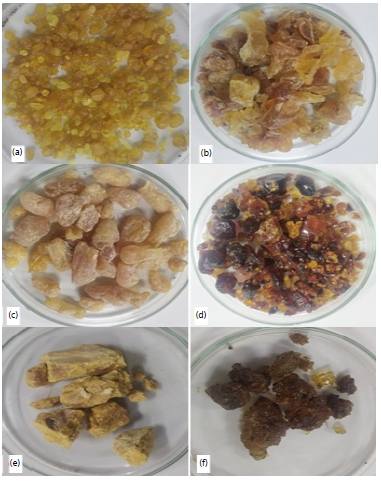
Traditional medicines, especially Unani medicine, have gained a lot of attention and interest recently as a source for the discovery of numerous significant pharmaceuticals used in medicine44. This study reveals the traditional Unani physicians’ ethnomedical applications of plant exudates. Drug identification is challenging when relying solely on the crude descriptions of drugs found in classical Unani literature. Since they lack distinctive diagnostic characteristics that help in their identification and are frequently contaminated with substances that have a similar appearance, it is challenging to determine the identity and purity of unorganised drugs. When there are numerous unorganised data sources and standard parameters cannot be developed for future use, the situation gets worse. It must therefore be concerned with their identity, the manner of collecting, and the duration of purification. Gums are taken from nature, therefore their availability changes with the weather and time of year. Extraction and purification are required processes after processing. Studies have demonstrated that differing storage conditions have an impact on gum quality, making storage another crucial process15. It is difficult to distinguish between the exudates since they physically resemble one another (Fig. 1). Some of these medications, such Samagh Arabī (Acacia arabica (Lam.) Willd), Katīra (Cochlospermum gossypium DC), Murr Makkī (Commiphora myrrha (Nees) Engl), Muql (Balsamodendron mukul Hook, ex Stocks), and Moochras (Salmalia malabarica Schott), are quite similar. It can be difficult to determine whether the several forms of a single remedy described in Unani literature are distinct species of the same plant or the other way around. For instance, Kundur comes in four varieties. Each category represents a different grade of the same species.
|
| Table 2: | Exudates employed in Unani system of medicine and its chemical constituents and pharmacological actions | |||
| Botanical name | Chemical constituents | Pharmacological activities | References |
| Acacia arabica (Lam.) Willd; Syn: Acacia nilotica (L.) Delile |
Galactose, 24-27% arabinose, 12-16% rhamnose, 15-16% glucuronic acid, 1.5-2.6% protein, 0.22-0.39% nitrogen, Ca, Mg and potassium salt of a acid (arabic acid) |
Antioxidant, nephroprotective, antimicrobial, anti-inflammatory, anticoagulant, anticarcinogenic, antidiabetic polysaccharide |
Nasir33 |
| Astragalus sarcocolla Dymock | Alkaloids, saponins, sterol, terpenoids, tannins, flavonoids | Antimicrobial, wound healing, antioxidant, cardiovascular disease | Wang et al.34 |
| Azadirachta indica A. Juss. | Glucosamine, galactose, D-glucose D-glucuronic acid, L- arabinose, L-fucose, mannose and xylose, alanine, amino-butyric acid, arginine, glycine |
Binding property, sustained release property, proteolytic activity |
Choudhary and Pawar9; Moniem et al.26 |
| Boswellia serrata Roxb. | Boswellic acids | Anti-inflammatory, anti-cancerous, anti-ulcerous | Sultana et al.22 |
| Butea monosperma (Lam.) Taub/ Butea frondosa Roxb. |
Tannins, mucilaginous material, pyrocatechin, Z-amyrin,β-sitosterone glucoside, sucrose, lactone-heneicosanoic acid-delta-lactone, laccijalaric esters I, II (Terpenic lac acid), jalaric esters I, II |
Anti-diarrheal, antimicrobial |
Sahu et al.35 |
| Commiphora myrrha | Resin up to 40%, gums up to 60%, curzerene, furanoeudesma-1,3-diene, and lindestrene, furanodiene, flavonoids, alkaloids, tannins, glycosides, steroids, saponins, terpenoids, magnesium, potassium, sodium, manganese,zinc, calcium and phosphorus, aluminum, scandium, chlorine, arsenic, mercury, lead |
Anti-diarrheal, anti-gastric ulcer, anti-inflammatory, antitumor, antibacterial, antimicrobial, antifungal, wound healing, analgesic, antioxidant, antihyperlipidemic, hepatoprotective |
Ahamad et al.25 |
| Commiphora wightii (Arn.) Bhandari Syn: Balsamodendron mukul Hook, ex Stocks |
Diterpenoids, triterpenoids, steroids, long-chain aliphatic tetrols, aliphatic esters, ferulates, lignans, carbohydrates, and a variety of inorganic ions besides minor amounts of sesamin |
Hypolipidemic, effect on platelet aggregation and fibrinolytic, thyroid stimulatory, anti-inflammatory, antiarthritic, antioxidant anti-atherosclerotic, cardioprotective, cytotoxic , antifertility, skin diseases, antihyper-glycemic, antimicrobial |
Sarup et al.6 |
| Convolvulus scammonia L. | Scammonin resin, dihydroxy cinnamic acid, beta-methylesculetin, ipuranol, sucrose, reducing sugar, starch, glycosidic acid, scammonic acid A, taurocholate and glycocholate of sodium |
Purgative, vasorelaxation, anti platelet aggregation, anticancer, cellular protective |
Tawfeeq et al.36 |
| Dorema ammoniacum D. Don | Salicylic acid, ammoresinol, ashamirone, sesquiterpene chroman diones, essential oils (Cuperene (14.31%) and β-Funebrene (12.74%), dshamirone, doremin, doremine A, ammodoremin |
Antibacterial, antifungal, acetylcholinesterase inhibitory, anticonvulsant, anti-inflammatory, analgesic, antioxidant, cytotoxic activity |
Mobeen et al.37 |
| Dracaena cinnabari Balf.f./ Pterocarpus marsupium Roxb |
Chalcones, homoisoflavans, flavones, biflavonoids (Cinnabarone), triflavonoids (Damalachawin), metacyclophanes (dracophane), flavonoids, homoisoflavonoids, chalcones, sterols and terpenoid |
Antifungal, antioxidant, cytotoxic, hypolipidemic, haemostatic, anti-diarrhetic, anti-ulcer, antimicrobial, antiviral, wound healing, anti-inflammatory, spasmolytic, inotropic, hypotensive and diuretic |
Mohammed et al.18, Al-Fatimi et al.19 |
| Euphorbia resinifera O. Berg | Resinous matter (18.32% ), diterpene (24.50%), triterpene (16.23%), tirucallane, triterpene, euphorol K, euphane triterpenehydroperoxide, euphorol J, kansuinone, triterpenoids and dihydroionol bisnorsesquiterpenes |
Anti-inflammatory |
Wang et al.38 |
| Ferula foetida (Bunge) Regel.; Syn: Ferula narthex, Boiss |
Resin (40 to 65%), gum (20 to 25%) and volatile oil (4 to 20%),ferulic acid, umbelliferone, saresinotannols, umbelliferone ethers, disulfides, tetra sulphides, assafoetidnol A, assafoetidnol B and Galbanic acid |
Neuroprotective, anticholesterolemic,anti-coagulant, anti-fertility, anti-fungal, anti-hepatotoxic, anti-inflammatory, antioxidant, anti-parasitic, anti-diabetic,anti-ulcerogenic, |
Daneshkazemi et al.39 |
| Ferula galbaniflua Boiss. et Buhse/Ferula gummosa Boiss |
Monoterpenic (myrtenol, menthe-1,8-dien-7-ol, pinocarvol isomers and 1,8-mentha-1,5-dien-8-ol), Terpenes, terpenoids, gumosin, cauferoside, gumosides A and B, feselol, ferilin, conferoside, ferocaulidin, ligupersin A, conferol, daucosterol. Essential oilcontains α-pinene (13%), β-pinene (2%), limonene (14%), terpinolene (10%), linalool (9%), β-myrcene (10%),Δ-3-carene (9%), butyl isovalerate (3%), α-terpinolene (2.5%), α-campholene aldehyde (1%), hexyl isovalerate (2%), γ-terpinene (6%), butanoic acid-3-3-dimethyl (1.5%) and phellandral (5%) |
Antispasmodic, anti-cancer, antimicrobial, insecticidal, anti-acetylcholine esterase, anticonvulsant, hypotensive, hypoglycemic,anticancer, antitumor, hypolipidemic, antimycobacterial, cytotoxic, and acaricidal |
Fallah et al.40 |
| Ferula persica Willd. | Resin (50-60%), gum (23-30%), essential oil (3-11%), Coumarins, sesquiterpenes, sesquiterpene coumarin glycosides and sulphurcontaining compounds |
Anti-hypertensive, anti-inflammatory, cancer chemo-preventive, anti-tumor, anti angiogenic, cytotoxic, antibacterial, antifungal, anti-leishmanial, cytotoxic and anticonvulsant |
Barzegar et al.41 |
| Liquedambar orientalis Mill. | Terpinen-4-ol, α-terpinol, sabinene and -terpinene along with cinnamyl cinnamete, phenylpropyl cinnamete, cinnamaldehyde, cinnamyl alcohol, ethyl cinnamate, methyl cinnamate and cinnamyl acetate |
Anti-ulcerogenic, antifungal, antibacterial, antioxidant, antiviral, Anticonvulsant, wound healing, anti-ulcerogenic and nematicidal |
Lingbeck et al.42 |
| Pinus roxburghii Sarg; Syn: Pinus longifolia Roxb. ex Lamb. |
Resin contains α-pinene (18.1%), longifolene (13.8%), carene (51.8%), pine oil contains α-pinene (20-30%), α-pinene (5-10%), α-3-carene (55-65 %), and longifolene and other terpenes (2-10 %), α and β-pinene, Δ-3-carene, longifolene, abietic acid (2-10 %), α and β-pinene, Δ-3-carene, longifolene, abietic acidand isopimaric acid phenolic (ferulic acid, p coumaric) acids and a lignin (pinoresinol) |
Antimicrobial, spasmolytic, antiseptic, expectorant, carminative, antioxidant, anthelmintic, antibacterial and analgesic |
Kaushik et al.17 |
| Prunus amagdalus Baill.Var. Dulcis/Prunus dulcis (Mill.) D.A. Webb. |
Aldobionic acid, L-arabinose, L-galactose, D-mannose, L-arabinose (4 parts), D-xylose (2 parts), D-galactose (3 parts) and D-glucouronic acid (1 part); aldobio uronic acid. Volatile oil contains octadecenoic acid (18.47%), 3-eicosene (17.04%), hexadecanoic acid (13.82%), benzyl salycilate (9.54%), 1-octadecene (7.28%), cetene (4.38%) and turmerone (3.2%) |
Wound healing, antioxidant, antibacterial, antifungal, anti-diabetic, anticancer, antimutagenic, antiviral, antiinflammatory, and insecticida activities |
Choudhary and Pawar9 |
| Shorea robusta Gaertn. | Alkaloids, carboxylic acids, fatty acids, phenols, saponins, steroids catechols, coumarins, proteins, tannins and volatile oils |
Antimicrobial, antifungal, analgesic, wound healing and antiulcer | Vashisht et al.43 |
| Styrax benzoin Dryand. Styrax tonkinensis Craib ex Hartwich |
Cinnamyl cinnamate 8-14%, methyl cinnamate 10-17%, cinnamic acid 4-7%,benzyl cinnamate 2-4%, vanillin, benzoic acid, phenylpropylic alcohol, p-coumaryl benzoate, siaresinolic acid, coniferyl benzoate |
Antibacterial, anti-biofilm, anticancer, antioxidant, flavouring agent, preservative, perfumes, cosmetics, and in hyperbilirubinemia |
Du et al.23 |
According to the Unani literature, most unorganized drugs have the following properties: Mujaffif (desiccative), Mugharrī (agglutinant), Muhallil (resolvent), Muddamil-i-Qurū (ulcer-causing), Dāfi’-i-Ta’affun (anti-septic), ābis (heamostatic), Qābi (astringent), Muqawwī (tonic), and Mughalliz (inspissant). Ulcers, wound healing, hemorrhages, hemorrhides, leucorrhoea, spermatorrhoea, inflammation, biliousness, mucous membrane irritation, and gastric ulcers are just a few of the conditions they are used to treat31. Because of their chelating and demulsent properties, gums preferentially absorb and mix with unpleasant substances without interacting with the stomach mucosa. They also cover the injured mucosa, protecting it from harmful substances’ corrosive effects and promoting recovery. Most gums have antibacterial, anti-inflammatory, antioxidant, anti-fungal, and wound-healing properties, according to scientific research. Most of the characteristics mentioned in Unani literature have been validated by scientific investigation (Table 2).
Due to its high essential oil content, gum resins such as ammoniacum, asafoetida, gamboge, myrrh, and scammony are among those most commonly utilized for medicinal purposes10. It has been found that essential oils, which are mixtures of physiologically active compounds, serve a number of biological purposes and are a great source of phytochemicals in food. Isoprenic derivatives are among the monoterpenes and sesquiterpenes that comprise most of the chemical constituents of essential oils. Certain monoterpenes, like as limonene and perillic acid, have been found to have anticancer effects in-vivo45. Sesquiterpene coumarins were tested for their ability to induce cell death in human breast and prostate cancer cell lines, MCF-7 and PC-3, as well as a healthy human embryonic stem cell line (NIH). With IC50 values of 30 and 32.1 g/mL, respectively, the PC-3 and MCF-7 cell lines exhibited considerable cytotoxic activity. There was no proof of toxicity in the NIH. Gum arabic therapy modifies the transcript levels of several genes that are known to be essential for cell division and/or the development of cancer in colonic tissue. Additionally, gum acacia therapy lowers the proteins’ levels of ß-catenin, a potent oncogene seen in colon cancers33. Gum, derived from various plant species like Acacia, is utilized for treating eye infections and discomfort, as well as skin conditions including sunburn, chapped lips, burns, cuts, and ulcers. It serves as a dietary component for digestive health, helping to alleviate issues such as diarrhea and stomach inflammation. Additionally, economically valuable gums are commonly incorporated into pesticide and medicinal formulations3. Gums and their essential oils, like mastic, acacia, and rosin, serve as food additives and are utilized in folk medicine for digestive disorders45.
CONCLUSION
Exudates (gums, resins, and oleo-gum resins) are interesting plant materials with unrealized potential that could be employed in drug development due to the accumulation of different metabolites. Among other things, these drugs are reported to have hepatoprotective, anti-inflammatory, antibacterial, and wound-healing properties. Furthermore, a range of plant exudates are an essential source of raw materials for the food and pharmaceutical industries, enabling the creation of valuable products like considerably less expensive medicines for common microbial illnesses.
SIGNIFICANCE STATEMENT
Despite the fact that plant gums have been the subject of extensive investigation, many of their potential therapeutic uses have not yet been fully explored. It is essential to define some standard reference parameters for the characterization of plant exudates using state-of-the-art chemistry and technology. Further research on isolated bioactive compounds from these plants’ exudates is necessary to further understand their method of action.
ACKNOWLEDGMENT
The authors are higly grateful to the library staff at NIUM, Bangaluru, Karnataka, India for providing the pertinent books, manuscripts, and other materials.
REFERENCES
- Saha, A., S. Tyagi, R.K. Gupta and Y.K. Tyagi, 2017. Natural gums of plant origin as edible coatings for food industry applications. Crit. Rev. Biotechnol., 37: 959-973.
- Makbul, S.A.A., S.I. Azmi and M.S. Akhtar, 2025. Crude Drugs of Unani Medicine, Volume 1: Application and Utility for Human Welfare. 1st Edn., Apple Academic Press, New York, USA, ISBN: 9781003637295, Pages: 634.
- Makbul, S.A.A., S.I. Azmi and M.S. Akhtar, 2025. Crude Drugs of Unani Medicine, Volume 2: Phytochemistry and Pharmacology Aspects. 1st Edn., Apple Academic Press, Boca Raton, USA, ISBN: 9781003637448, Pages: 410.
- Husain, M.K. and M.S. Akhtar, 2025. An Evidence-Based Review on Hepatoprotective Plants and Crude Drugs, Traditionally Used in the Unani System of Medicine. In: Crude Drugs of Unani Medicine, Volume 1: Application and Utility for Human Welfare, Makbul, S.A.A., S.I. Azmi and M.S. Akhtar (Eds.), Apple Academic Press, New York, USA, ISBN: 9781003637295, pp: 3-39.
- Azmi, S.I., S.A.A. Makbul, Sayeedur Rahman, M.A. Ali and M.S. Akhtar, 2025. Phytochemistry and Pharmacology of Aromatic Medicinal Plants Used in Unani Medicare System. In: Crude Drugs of Unani Medicine, Volume 2: Phytochemistry and Pharmacology Aspects, Makbul, S.A.A., S.I. Azmi and M.S. Akhtar (Eds.), Apple Academic Press, New York, USA, ISBN: 9781003637448, pp: 3-66.
- Sarup, P., S. Bala and S. Kamboj, 2015. Pharmacology and phytochemistry of oleo-gum resin of Commiphora wightii (Guggulu). Scientifica, 2015.
- Licá, I.C.L., A.M. dos Santos Soares, L.S.S. de Mesquita and S. Malik, 2018. Biological properties and pharmacological potential of plant exudates. Food Res. Int., 105: 1039-1053.
- Ratnam, K.V., G.T. Reddy and R.R.V. Raju, 2019. Therapeutic importance of gums in folk medicine from Eastern Ghats, Andhra Pradesh. Asian J. Pharm. Clin. Res., 12: 300-302.
- Choudhary, P.D. and H.A. Pawar, 2014. Recently investigated natural gums and mucilages as pharmaceutical excipients: An overview. J. Pharm., 2014.
- Parimal, K., A. Khale and K. Pramod, 2011. Resins from herbal origin and a focus on their applications. Int. J. Pharm. Sci. Res., 2: 1077-1085.
- Vishnuprasad, C.N., N.S. Pradeep, Y.W. Cho, G.G. Gangadharan and S.S. Han, 2013. Fumigation in Ayurveda: Potential strategy for drug discovery and drug delivery. J. Ethnopharmacol., 149: 409-415.
- Husain, A., G.D. Sofi, R. Dang, R.R.H. Shobha and A.K.K. Mueen, 2010. Production of crude drugs in Unani system of medicine. Pharmacogn. J., 2: 61-63.
- Sisay, M. and T. Gashaw, 2017. Ethnobotanical, ethnopharmacological, and phytochemical studies of Myrtus communis Linn: A popular herb in Unani system of medicine. J. Evidence Based Complementary Altern. Med., 22: 1035-1043.
- Amiri, M.S., V. Mohammadzadeh, M.E.T. Yazdi, M. Barani, A. Rahdar and G.Z. Kyzas, 2021. Plant-based gums and mucilages applications in pharmacology and nanomedicine: A review. Molecules, 26.
- Mohi-Ud-Din, R., P.M. Ahad and Z.A. Bhat, 2020. Pharmacognostic standardization and phytochemical characteristics of the roots of Astragalus grahamianus Royle ex. Benth. Res. J. Pharm. Technol., 13: 4310-4314.
- Nussinovitch, A., 2009. Plant Gum Exudates of the World. 1st Edn., CRC Press, Boca Raton, Florida, ISBN: 9780429150463, Pages: 427.
- Kaushik, P., D. Kaushik and S.L. Khokra, 2013. Ethnobotany and phytopharmacology of Pinus roxburghii Sargent: A plant review. J. Integr. Med., 11: 371-376.
- Mohammed, Y.H.E., H.S. Deepika, F.H. Al-Ostoot, Zabiulla, Anilakumar and S.A. Khanum, 2019. In vitro evaluation of hypolipidemic effect of extracts of medicinal Dracaena cinnabari Balf. f. resin. Asian J. Pharm. Clin. Res., 12: 118-120.
- Al-Fatimi, M., 2018. Ethnobotanical survey of Dracaena cinnabari and investigation of the pharmacognostical properties, antifungal and antioxidant activity of its resin. Plants, 7.
- Fattorusso, E., V. Lanzotti, O. Taglialatela-Scafati, G.C. Tron and G. Appendino, 2002. Bisnorsesquiterpenoids from Euphorbia resinifera Berg. and an expeditious procedure to obtain resiniferatoxin from its fresh latex. Eur. J. Org. Chem., 2002: 71-78.
- Al-Jenoobi, F.I., A.A. Al-Thukair, M.A. Alam, F.A. Abbas, A.M. Al-Mohizea, K.M. Alkharfy and S.A. Al-Suwayeh, 2014. Modulation of CYP2D6 and CYP3A4 metabolic activities by Ferula asafetida resin. Saudi Pharmaceut. J., 22: 564-569.
- Sultana, A., Khaleeq Ur Rahman, A.R. Padmaja and Shafeeq Ur Rahman, 2013. Boswellia serrata Roxb. a traditional herb with versatile pharmacological activity: A review. Int. J. Pharm. Sci. Res., 4: 2106-2117.
- Du, J., H. Singh and T.H. Yi, 2016. Antibacterial, anti-biofilm and anticancer potentials of green synthesized silver nanoparticles using benzoin gum (Styrax benzoin) extract. Bioprocess. Biosyst. Eng., 39: 1923-1931.
- Sayeedur Rahman, S.A.A. Makbul and M.A. Khan, 2020. Mastagi (Pistacia lentiscus L.) an important drug of Unani system of medicine: A review. Int. J. Pharm. Pharm. Res., 18: 932-945.
- Ahamad, S.R., A.R. Al-Ghadeer, R. Ali, W. Qamar and S. Aljarboa, 2017. Analysis of inorganic and organic constituents of myrrh resin by GC-MS and ICP-MS: An emphasis on medicinal assets. Saudi Pharm. J., 25: 788-794.
- Moniem, M.E., E.A. Hassan and M.E. Osman, 2018. Characterization and rheological behavior of neem gum (Azadirachta indica). Int. J. Chem. Stud., 6: 1977-1981.
- Özbek, A.G. and S.E. Bilek, 2018. Properties and usage of Liquidambar orientalis. Clin. Nutr. Metab., 5.
- Salamatullah, A.M., 2022. Convolvulus arvensis: Antioxidant, antibacterial, and antifungal properties of chemically profiled essential oils: An approach against nosocomial infections. Life, 12.
- Khan, H.M.A., 2014. Muhit-I-Azam. 3rd Edn., Central Council for Research in Unani Medicine, Delhi, India, ISBN: 9788187748380, Pages: 977.
- Khan, H.M.A., 2018. Muhit-I-Azam. 4th Edn., Central Council for Research in Unani Medicine, Delhi, India, ISBN: 9788187748540, Pages: 3806.
- Rates, S.M.K., 2001. Plants as source of drugs. Toxicon, 39: 603-613.
- Gurib-Fakim, A., 2006. Medicinal plants: Traditions of yesterday and drugs of tomorrow. Mol. Aspects Med., 27: 1-93.
- Nasir, O., 2013. Renal and extrarenal effects of gum Arabic (Acacia senegal)-What can be learned from animal experiments? Kidney Blood Pressure Res., 37: 269-279.
- Wang, D., Y. Zhuang, Y. Tian, G.N. Thomas, M. Ying and B. Tomlinson, 2012. Study of the effects of total flavonoids of Astragalus on atherosclerosis formation and potential mechanisms. Oxid. Med. Cell. Longevity, 2012.
- Sahu, M.C. and R.N. Padhy, 2013. In vitro antibacterial potency of Butea monosperma Lam. against 12 clinically isolated multidrug resistant bacteria. Asian Pac. J. Trop. Dis., 3: 217-226.
- Tawfeeq, A.T., I.H. Hassan, H.A.D.M. Kadhim and Z.T. Abdul Haffid, 2012. Convolvulus scammonia crude alkaloids extract induces apoptosis through microtubules destruction in mice hepatoma H22 cell line. Iraqi J. Cancer Med. Genet., 5: 134-146.
- Abdul Mobeen, M.A. Siddiqui, M.A. Quamri, M. Itrat and M.I. Khan, 2018. Therapeutic potential of Ushaq (Dorema ammoniacum D. Don): A unique drug of Unani medicine. Int. J. Unani Integr. Med., 2: 11-16.
- Wang, S.Y., C. Huang, R.K. Sun, L.N. Lu and H.G. Liang et al., 2019. New tirucallane triterpenoids from the dried latex of Euphorbia resinifera. Phytochem. Lett., 29: 220-224.
- Daneshkazemi, A., H. Zandi, A. Davari, M. Vakili, M. Emtiazi, R. Lotfi and S.M.R. Masoumi, 2019. Antimicrobial activity of the essential oil obtained from the seed and oleo-gum-resin of Ferula assa-foetida against oral pathogens. Front. Dent., 16: 113-120.
- Fallah, F., F. Emadi, A. Ayatollahi, S. Taheri, M.K. Yazdi and P.K. Rad, 2015. The anti-mycobacterial activity of the extract of Ferula gummosa. Int. J. Mycobacteriol., 4: 166-166.
- Barzegar, A., M.A. Salim, P. Badr, A. Khosravi and S. Hemmati et al., 2019. Persian asafoetida vs. sagapenum: Challenges and opportunities. Res. J. Pharmacogn., 7: 71-80.
- Lingbeck, J.M., C.A. O’Bryan, E.M. Martin, J.P. Adams and P.G. Crandall, 2015. Sweetgum: An ancient source of beneficial compounds with modern benefits. Pharmacogn. Rev., 9: 1-11.
- Vashisht, S., M.P. Singh and V. Chawla, 2017. A comparative pharmacognostic evaluation of different extracts of Shorea robusta Gaertn. f. Resin. Int. J. Pharm. Phytopharmacological Res., 7: 1-5.
- Abdallah, E.M., A.S. Khalid and N. Ibrahim, 2009. Antibacterial activity of oleo-gum resins of Commiphora molmol and Boswellia papyrifera against methicillin resistant Staphylococcus aureus (MRSA). Sci. Res. Essay, 4: 351-356.
- Spyridopoulou, K., A. Tiptiri-Kourpeti, E. Lampri, E. Fitsiou and S. Vasileiadis et al., 2017. Dietary mastic oil extracted from Pistacia lentiscus var. chia suppresses tumor growth in experimental colon cancer models. Sci. Rep., 7.
How to Cite this paper?
APA-7 Style
Akhtar,
M.S., Makbul,
S.A., Azmi,
S.I. (2026). Phytopharmacology and Therapeutic Applications of Some Commonly Used Gums, Resins and Oleo-Gum Resins in Unani System of Medicine. Trends in Pharmacology and Toxicology, 2(2), 86-102. https://doi.org/10.21124/tpt.2026.86.102
ACS Style
Akhtar,
M.S.; Makbul,
S.A.; Azmi,
S.I. Phytopharmacology and Therapeutic Applications of Some Commonly Used Gums, Resins and Oleo-Gum Resins in Unani System of Medicine. Trends Pharm. Toxicol. 2026, 2, 86-102. https://doi.org/10.21124/tpt.2026.86.102
AMA Style
Akhtar
MS, Makbul
SA, Azmi
SI. Phytopharmacology and Therapeutic Applications of Some Commonly Used Gums, Resins and Oleo-Gum Resins in Unani System of Medicine. Trends in Pharmacology and Toxicology. 2026; 2(2): 86-102. https://doi.org/10.21124/tpt.2026.86.102
Chicago/Turabian Style
Akhtar, Mohd., Sayeed, Shaikh Ajij Ahmed Makbul, and Shamim Irshad Azmi.
2026. "Phytopharmacology and Therapeutic Applications of Some Commonly Used Gums, Resins and Oleo-Gum Resins in Unani System of Medicine" Trends in Pharmacology and Toxicology 2, no. 2: 86-102. https://doi.org/10.21124/tpt.2026.86.102

This work is licensed under a Creative Commons Attribution 4.0 International License.